Growing a beard sounds simple until you actually try it. One week you’ve got a clean, confident 3-day shadow. Six weeks later you’re staring at a patchy, itchy mess wondering if you should just shave it all off and start over. This is the exact moment most men give up, and it’s also the exact moment a good barber earns their money.
This guide walks through the entire journey from stubble to full beard the way a seasoned barber would explain it in the chair: plainly, honestly, and with the kind of detail that actually changes how your beard turns out. You’ll learn how facial hair grows, how barbers read your face before they touch a clipper, what to expect during the dreaded “awkward phase,” which products are worth your money, how much the whole process should cost, and how to handle every hair type from straight to coily. By the end, you’ll have a week-by-week plan you can actually follow, plus answers to the questions men ask most often in the chair.
Key Takeaways
- A 3-day shadow is a starting point, not a finished look. Full beards typically take 2 to 4 months to reach their mature shape, depending on genetics and hair texture.
- The “awkward phase” (roughly weeks 2 through 4) is biologically normal. Patchiness during this window usually resolves on its own if you resist the urge to trim too early.
- Face shape, hair growth pattern, and skin condition determine which beard style will actually work for you, which is why a barber consultation before you commit matters.
- The neckline, cheek line, and mustache are the three structural lines that define whether a beard looks intentional or neglected. Get these wrong and nothing else matters.
- Investing in a barbershop relationship during the transition, rather than trying to DIY the whole thing, typically saves money and frustration in the long run by avoiding ingrowns, botched lines, and regrowth setbacks.
From Stubble to Statement — Why the Transition Matters
What a 3-day shadow actually is and why it’s a starting point, not a destination
A 3-day shadow is exactly what it sounds like: the visible stubble that appears roughly 72 hours after your last shave. At this stage, hair follicles that were cut flush to the skin have pushed through again, creating that rough, textured look that reads as rugged rather than scruffy. It’s a popular look on its own, but it’s also the launchpad for a full beard, and that distinction matters more than most men realize.
Here’s the thing a lot of guys get wrong: they treat the 3-day shadow like a finish line instead of a mile marker. They like how it looks, they get compliments, and then they panic the moment it starts looking uneven around week two. Understanding that the shadow is simply the first visible checkpoint in a much longer process helps set realistic expectations from day one. Your barber sees this all the time. The clients who succeed are the ones who understand they’re signing up for a process, not an event.
The cultural and historical weight of the full beard
Beards have carried meaning for thousands of years. Ancient Egyptian pharaohs wore false metal beards as symbols of divine authority. Greek philosophers grew beards to signal wisdom and intellectual seriousness, so much so that Alexander the Great’s order for his soldiers to shave was considered radical and controversial at the time. In many cultures across history, a full beard has signified maturity, status, and in some religious traditions, spiritual devotion.
That weight hasn’t disappeared. Today, a full beard still reads as a deliberate choice rather than an accident, which is exactly why the transition period matters so much. A shaped, well-maintained beard communicates intention. A patchy, unkept one communicates the opposite, regardless of what the man underneath it is actually like. Barbers aren’t just cutting hair during this process. They’re helping you control a signal that other people read instantly, often subconsciously.
Why most men fail the transition on their own
Most men who attempt the stubble-to-beard transition without professional guidance stumble for the same handful of reasons. They trim too early out of impatience. They ignore the neckline until it creeps up toward the jaw. They use whatever product is sitting in their bathroom cabinet, often something designed for scalp hair, not facial hair. And they try to power through the awkward phase alone instead of getting a check-in appointment that could have saved the shape.
A barber brings something you can’t replicate with a mirror and a pair of trimmers: a trained eye that has seen hundreds of transitions and knows which patchy section will fill in and which one won’t, which growth pattern suits your face and which one fights it, and when patience is the right call versus when intervention is needed. This guide draws on exactly that kind of accumulated chair-side knowledge.
Understanding How Beard Hair Actually Grows

The biology of facial hair growth: follicles, cycles, and hormones
Facial hair grows out of follicles embedded in the dermis, and each one cycles through three phases: anagen (active growth), catagen (transition), and telogen (resting, followed by shedding). According to the American Academy of Dermatology, scalp hair follicles can stay in the anagen phase for years, but facial hair follicles typically have a shorter anagen phase, which is part of why beards grow to a certain length and then plateau rather than growing indefinitely like head hair.
Testosterone and its more potent derivative, dihydrotestosterone (DHT), drive facial hair growth by binding to androgen receptors in facial follicles. This is why facial hair growth accelerates during and after puberty, and why men with higher androgen sensitivity in facial follicles often grow thicker beards even without dramatically different testosterone levels than men with sparser growth. Genetics determine how many of those receptors you have and how sensitive they are, which is the real reason beard density varies so much between men.
Growth rates by face zone (upper lip, chin, cheeks, neck)
Not all facial zones grow at the same rate, and this unevenness is completely normal. Most men see mustache and chin growth accelerate first, since these areas tend to have the highest concentration of androgen-sensitive follicles. Cheeks, particularly the upper cheek near the cheekbone, often lag significantly behind, which is the single biggest source of frustration during the transition.
| Face zone | Typical growth speed | Common pattern |
| Mustache | Fast | Often the first area to look full |
| Chin | Fast to moderate | Usually fills in solidly within 3-4 weeks |
| Jawline | Moderate | Steady, even growth for most men |
| Upper cheeks | Slow | Most prone to patchiness |
| Neck | Fast | Grows quickly but requires early shaping |
Knowing your personal growth map before you start lets you (and your barber) plan around the slow zones instead of being surprised by them.
How hair texture affects the transition process
Hair texture changes how a beard behaves at every stage. Straight hair tends to lie flat and can look sparse even when follicle density is decent, since there’s less visual volume per strand. Wavy and curly hair adds natural fullness and can mask minor patchiness, but it also tangles more easily and is more prone to becoming unruly without regular shaping. Coily and kinky hair curls back on itself tightly, which increases the risk of ingrown hairs but also tends to produce the fullest visual density once it grows past the awkward early stage.
Hair Texture is one of the single biggest variables a barber assesses before recommending a style or a product routine, because a plan that works beautifully for straight hair can actively work against coily hair, and vice versa.
Genetics, ethnicity, and what they mean for your beard journey
Genetics determine follicle density, androgen receptor sensitivity, and growth rate, and these factors vary across ethnic groups as a statistical tendency, though individual variation within any group is enormous. Research published in the International Journal of Trichology has noted differences in facial hair density and growth patterns across populations, but the practical takeaway for you isn’t a stereotype, it’s a reminder: comparing your timeline to a friend’s, a celebrity’s, or an influencer’s beard journey is close to meaningless. Your genetics set your own baseline, and a barber’s job is to work with that baseline rather than chase someone else’s result.
Reading Your Face: How Barbers Assess Your Starting Point
The barber’s first look: what they’re really evaluating
When you sit down for a beard consultation, an experienced barber is running through a mental checklist before they say a word about style. They’re looking at your natural hairline and growth pattern, the density and direction of growth across each facial zone, your skin’s current condition, and the proportions of your face. This first look typically takes less than a minute, but it shapes every recommendation that follows.
Face shape and how it dictates beard style choices
Face shape is one of the most important variables in beard styling because a beard can be used to balance proportions. The general principle barbers work from is simple: a beard should soften angles that are too sharp and add structure to shapes that lack definition.
| Face shape | General goal | Recommended beard approach |
| Round | Add length and angles | Shorter sides, more length at the chin, sharper cheek lines |
| Square | Soften sharp angles | Rounded edges, slightly longer length to soften the jaw |
| Oval | Maintain balance | Most styles work well; full beards complement natural proportions |
| Long/Rectangular | Add width, reduce length | Fuller cheeks and sides, shorter chin length |
| Heart-shaped | Add width at the jaw | Fuller beard at the jawline to balance a narrower chin |
| Diamond | Soften cheekbones | Fuller growth at the jaw and chin, lighter on the cheeks |
Skin type, skin tone, and underlying conditions that affect the plan
Skin matters just as much as hair. Dry skin underneath a growing beard tends to flake and itch more, which can tempt men to shave out of discomfort rather than style preference. Oily skin can trap product buildup against the follicle, increasing the risk of irritation or breakouts. Barbers also check for conditions like folliculitis, eczema, or psoriasis on the jaw and neck, since these can flare during the early growth stages when skin is irritated by new, sharp hair growth. A barber who spots one of these conditions early will often recommend a dermatologist visit before pushing ahead with aggressive shaping, which protects both your skin and your eventual beard.
Mapping the growth pattern before touching a single clipper
Before any trimming happens, a thorough barber will study the direction your hair grows in each zone, called the grain. Hair doesn’t grow uniformly in one direction across your whole face. Cowlicks, swirls, and direction changes around the jaw and neck are common, and cutting against the grain in these zones can create an uneven, choppy appearance even with a perfectly even clipper guard. This mapping step is quick but it’s the difference between a clean transition and weeks of unnecessary frustration.
The Stubble Stage: Working With What You Have on Day 3
Why day 3 stubble is both a blessing and a trap
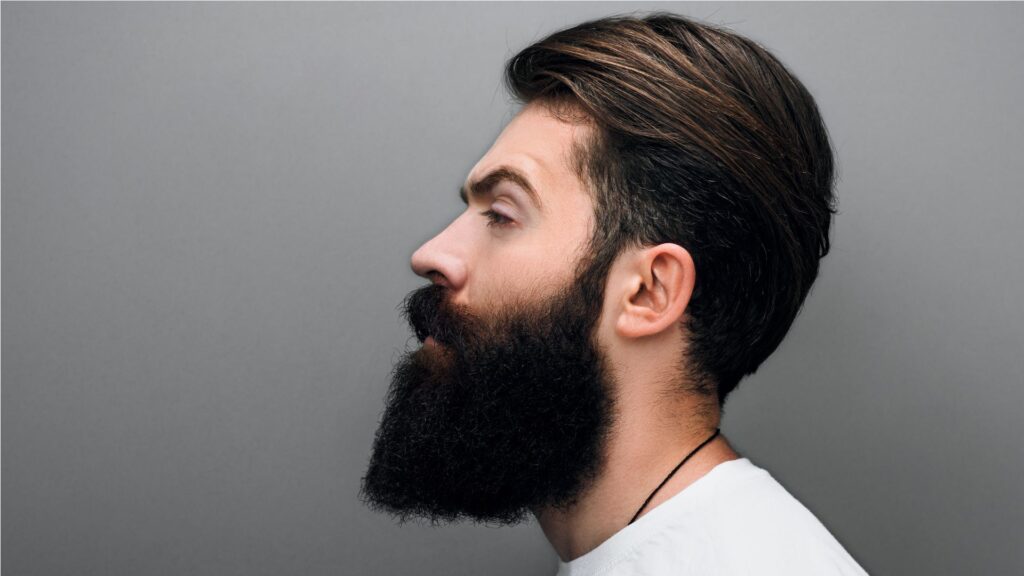
The 3-day shadow looks good on almost everyone, which is exactly why it’s dangerous. It’s tempting to think the hard part is already done. In reality, day 3 stubble tells you very little about how your beard will look at day 20 or day 60, since growth rates and patchiness patterns haven’t fully revealed themselves yet. Treat the stubble stage as useful information gathering, not a finished product.
Clipper guards, grades, and the art of evening stubble out
Barbers use clipper guards numbered by millimeter length, and at the stubble stage, most work in the range of a number 1 (around 3mm) to a number 3 (around 10mm) depending on how much length you’re trying to preserve versus even out. The goal at this stage isn’t to shape the beard yet, it’s to create a uniform canvas by trimming away any patches that grew noticeably faster or in a different direction than the surrounding area.
Defining the neckline and cheek line at the stubble stage
Even at day 3, barbers typically start lightly defining the neckline and cheek line rather than waiting. A neckline that’s established early and maintained consistently is much easier to keep clean than one that’s ignored for weeks and then has to be corrected all at once. The general rule for the neckline is to find the natural curve about an inch and a half to two inches above the Adam’s apple, following the jawline’s natural angle rather than cutting a harsh straight line across the throat.
Products that matter at the stubble phase
At this early stage, the product list should stay simple. A gentle, sulfate-free face wash prevents dryness. A lightweight, non-comedogenic moisturizer keeps the skin underneath comfortable as new hair pushes through. Beard oil isn’t strictly necessary yet since there isn’t much length to condition, but some barbers recommend starting it early anyway to build the habit and begin softening the hair before it gets longer and coarser.
The Awkward Phase: Surviving Weeks 2 Through 4
Why the awkward phase exists and what’s actually happening to your skin and hair
Somewhere around week two, most men hit a wall. The beard looks patchy, uneven, and frankly a little rough. This happens because different follicles are at different points in their individual growth cycles. Some hairs that started growing on day one are now visibly longer, while follicles that entered the anagen phase later are just barely becoming visible. The result is a temporary, uneven appearance that has nothing to do with whether your beard will eventually fill in.
Barber strategies to manage patchiness during the grow-out
A good barber will often recommend a light, strategic trim during this phase, not to shorten the beard overall, but to trim the faster-growing areas down slightly so they don’t outpace the slower zones as dramatically. This technique, sometimes called “training” the beard, helps create the illusion of even growth while the slower follicles catch up. It’s a subtle skill, and it’s one of the clearest reasons DIY attempts go wrong: an untrained hand will often trim the wrong areas and make the patchiness look worse rather than better.
Itch, ingrown hairs, and skin irritation: the real solutions
Beard itch during weeks two through four is extremely common and is caused by new hair curling back and brushing against surrounding skin, plus dry skin underneath the growing hair. Beard oil with carrier oils like jojoba or argan helps soften the hair shaft and reduce that scratching sensation. Ingrown hairs, more common in curly and coily hair types, are best managed with gentle exfoliation using a soft-bristled beard brush and resisting the urge to pick, which can lead to scarring and worse irritation.
What to tell your barber during this phase
This is the phase where communication with your barber matters most. Tell them specifically which areas itch, which areas feel irritated, and whether you’re seeing any ingrown hairs or redness. This information lets them adjust the trimming plan and product recommendations in real time rather than following a generic script that doesn’t account for your actual skin response.
Shaping vs. Trimming: Two Very Different Skills
The difference between trimming length and shaping structure
Trimming reduces length evenly across an area. Shaping defines the structural lines of the beard, the neckline, cheek line, and mustache border, that give it an intentional silhouette. Many men conflate the two, but they require different tools, different techniques, and frankly different levels of skill. You can trim your own beard with reasonable success using a quality trimmer. Shaping, especially cheek line and neckline work, is much harder to do accurately on yourself because you’re working with a mirror image and limited visibility of your own neck and jaw angles.
The tools barbers use and why they matter
| Tool | Primary use | Why it matters |
| Straight razor | Precision edging along the neckline and cheek line | Creates the cleanest, sharpest line definition |
| Clippers with guards | Overall length reduction | Fast, consistent length control across large areas |
| Detail trimmer | Fine edging around lips and jaw | Allows precision work in tight areas |
| Beard scissors | Hand-cutting stray or uneven hairs | Useful for fine-tuning without removing too much length |
| Straight edge comb | Guide for straight line cuts | Ensures neckline and cheek line symmetry |
Fading the beard into the haircut: the craft of the blend
A well-executed beard fade connects the sideburns and beard seamlessly into the haircut, avoiding the harsh line where a beard “starts” and the haircut “ends.” This blending work requires clipper-over-comb technique and careful attention to how the hair density changes from scalp to face. It’s one of the more advanced skills in a barber’s toolkit, and it’s a major reason men seek out a barbershop near me rather than attempting a full beard and haircut blend at home.
When to shape and when to leave it alone
Early in the transition, less is more. Shaping too aggressively before the beard has filled in removes density you’ll want later and can accentuate patchy areas rather than hide them. The general rule barbers follow: define the neckline and cheek line early and consistently, but hold off on heavier shaping of the overall beard silhouette until at least the one-month mark, when enough growth exists to actually see the beard’s true shape.
Beard Styles for Every Stage of Growth
Short beard styles (weeks 1-4)
During the first month, styles that work with shorter, uneven growth include the heavy stubble look (lengths kept short and uniform with clippers), the “boxed” short beard (tight neckline and cheek line with minimal length on top), and the circle beard for men whose mustache and chin connect well but whose cheeks are still filling in.
Medium beard styles (months 1-3)
By month two or three, most men have enough length and density to move into medium styles: the classic full beard at a moderate length, the ducktail beard (tapered to a point at the chin), or the Van Dyke for men who prefer a more defined mustache paired with chin growth while keeping the cheeks trimmed shorter.
Full and long beard styles (month 3 and beyond)
Past the three-month mark, men with strong growth can move into longer, fuller styles: the classic long full beard, the “garibaldi” (full, rounded, and voluminous), or styled variations that incorporate braiding or waxed shaping for the mustache. These styles require the most maintenance but also offer the most dramatic visual payoff after a long transition.
Matching the style to the face shape at each stage
Even as the beard grows longer, the face-shape principles from earlier in this guide still apply. A round face benefits from added chin length even at the medium stage. A long face should avoid letting chin length run away from it and instead focus on fuller cheek coverage. Revisiting this match at each growth milestone, rather than assuming the original plan still fits, is something a barber will naturally do at each visit.
The Barber’s Role: What Happens in the Chair at Each Visit
Visit 1: the consultation and the plan
The first visit is about assessment, not cutting. A thorough barber will discuss your goals, examine your growth pattern and face shape, flag any skin concerns, and set expectations for the timeline ahead. This is also when a realistic target style gets chosen based on everything discussed in the earlier sections of this guide.
Visit 2 and 3: maintenance and shaping during growth
These visits, typically scheduled two to three weeks apart, focus on neckline and cheek line maintenance, light trimming of faster-growing zones to even things out, and ongoing check-ins about skin condition and product routine. This is where the “training” technique mentioned earlier comes into play most heavily.
Visit 4 onward: full beard grooming sessions
Once the beard reaches its target length, visits shift toward full grooming: overall shape maintenance, detailed line work, and often incorporating a straight razor neck shave for the cleanest possible finish below the beard line.
How often you should be visiting the barbershop during a transition
Most barbers recommend visits every two to three weeks during the active growth phase, tapering to every three to four weeks once the beard reaches its mature length and only needs shape maintenance rather than active training.
Products That Actually Work: A Barber’s Honest Breakdown
Beard oils: what they do, what’s in them, and which to avoid
Beard oil conditions both the hair shaft and the skin underneath, reducing itch and flakiness while adding shine and softness. Quality beard oils are built on carrier oils like jojoba, argan, or sweet almond oil, often blended with lighter essential oils for scent. Avoid oils with heavy mineral oil as the primary base, since it sits on top of the skin rather than absorbing, which can trap moisture and irritate follicles rather than soothe them.
Beard balms vs. beard butter: breaking down the difference
| Feature | Beard balm | Beard butter |
| Base ingredients | Beeswax, oils, butters | Whipped shea or cocoa butter, oils |
| Hold strength | Medium to strong | Light to medium |
| Best for | Taming flyaways, light styling | Deep conditioning, softness |
| Texture | Solid, melts with body heat | Whipped, lighter texture |
| Ideal hair type | Coarse, curly, or longer beards | Driest skin and hair, all lengths |
Washes, conditioners, and why regular shampoo is the enemy
Regular scalp shampoo is typically too harsh for facial skin and beard hair, stripping natural oils that the beard and the skin beneath it actually need. A dedicated beard wash uses gentler surfactants and is usually paired with a lightweight conditioner formulated specifically for coarser facial hair texture.
Styling products for hold, texture, and finish
For longer beards, styling waxes offer stronger hold for shaping the mustache or taming stray hairs, while lighter styling creams add texture and manageability without the stiffness of wax.
Ingredient breakdown table: what to look for and what to skip
| Look for | Why it helps | Skip | Why to avoid |
| Jojoba oil | Closely mimics natural skin oils | Mineral oil (as primary base) | Sits on skin, can clog follicles |
| Argan oil | Rich in vitamin E, softens hair | Sulfates | Strips natural moisture |
| Shea butter | Deep moisture for dry skin | Synthetic fragrance (heavy concentration) | Can irritate sensitive skin |
| Vitamin E | Antioxidant support for skin health | Alcohol (as a leading ingredient) | Overly drying to hair and skin |
| Jajoba or almond carrier oils | Lightweight absorption | Petroleum-based waxes (as sole hold agent) | Difficult to wash out, buildup-prone |
Common Mistakes Men Make During the Transition

Trimming too early and killing the momentum
The single most common mistake is reaching for trimmers the moment the beard looks patchy, rather than waiting through the awkward phase. Premature trimming resets the clock on the very growth that would have filled things in.
Neglecting the neckline and losing the shape
Skipping neckline maintenance lets the hairline creep upward toward the jaw, eventually making the beard look like it has no defined bottom edge at all. This is one of the fastest ways to make an otherwise good beard look unkempt.
Skipping the barber and trying to DIY the whole process
Attempting the entire transition alone, especially the shaping and line work, often leads to uneven results that then require professional correction anyway, meaning the DIY approach frequently costs more time and money in the end than simply booking consistent appointments from the start.
Using the wrong products for your hair texture and skin type
Applying a heavy balm meant for coarse, curly hair onto fine, straight hair can leave it looking greasy and weighed down, while using a light oil alone on dry, coily hair often isn’t enough moisture. Matching product to texture is not optional, it’s foundational.
Beard Transition Costs: What to Budget and Why It’s Worth It
Barbershop pricing for beard work across service types
| Service | Typical price range |
| Beard trim only | 15-30 |
| Beard shape and line-up | 20-40 |
| Full haircut and beard combo | 35-65 |
| Straight razor neck/line cleanup | 10-20 (often added to another service) |
| Full beard styling session (longer beards) | 30-50 |
At-home product costs and what’s actually necessary
A basic at-home routine, beard wash, beard oil, and a quality trimmer for touch-ups between visits, typically runs $60 to $120 as a one-time setup cost, with ongoing monthly product spend averaging $15 to $25.
The cost of doing it wrong: ingrowns, patchy regrowth, skin damage
Skipping professional guidance and shaping incorrectly can lead to costs that aren’t always obvious upfront: dermatologist visits for persistent ingrown hairs or folliculitis, lost growth time from unnecessary trims, and the cost of eventually visiting a barber anyway to fix an uneven shape, often at a higher price than a correction would have cost from the start.
Value vs. price: why a good barber saves you money long-term
A skilled barber who gets the shape right the first time, catches skin issues early, and helps you avoid the common mistakes outlined above ultimately saves money by preventing the cycle of trial, error, and correction that DIY transitions often fall into.
Beard Care Across Different Hair Types and Ethnicities
Straight hair beards: the challenges and the advantages
Straight beard hair tends to look thinner visually even with good density, and it can appear patchy more easily since there’s less natural volume to disguise gaps. The advantage is that straight hair is generally easier to shape with sharp, clean lines since it lies flat and predictable.
Wavy and curly beard hair: managing growth and shape
Wavy and curly hair adds natural fullness, which helps mask minor unevenness, but it also tangles more and benefits from regular brushing with a boar-bristle beard brush to keep the direction of growth consistent and prevent matting.
Coily and kinky beard hair: specialized techniques and products
Coily and kinky hair types have the highest risk of ingrown hairs because the curl pattern causes hair to curve back into the skin after cutting. Barbers working with this hair type often recommend trimming with a slight length buffer rather than cutting flush to the skin, along with regular gentle exfoliation to prevent ingrowns.
Mixed hair texture beards: when one approach doesn’t cover all zones
Many men have genuinely mixed texture across their face, for example, straighter hair on the cheeks and tighter curl at the chin and neck. In these cases, a single product or technique rarely works for the whole beard, and barbers often recommend zone-specific product application rather than a one-size-fits-all routine.
Neckline, Cheek Line, and Mustache: The Three Lines That Define Everything
The neckline: where it should sit and why most men get it wrong
The ideal neckline sits about an inch and a half above the Adam’s apple, following a gentle U-shape that mirrors the jaw’s natural curve. The most common mistake is cutting it too high, which shortens the apparent length of the jaw and can make the whole face look smaller.
The cheek line: natural vs. sculpted and how to decide
A natural cheek line simply follows wherever the beard growth naturally stops, which works well for men with high, even growth. A sculpted cheek line is trimmed slightly lower than the natural growth edge to create a crisper, more deliberate look, which tends to suit men whose natural cheek growth is patchy or uneven.
Mustache shaping and how it connects to the full beard look
The mustache should be trimmed to just cover the top lip line without hanging over it, and its width should visually connect with the rest of the beard rather than looking like a separate feature. For fuller beard styles, a slightly fuller mustache usually balances the overall silhouette better than a thin one.
Maintaining all three lines between barbershop visits
Between appointments, a quality detail trimmer can help you maintain the established neckline and stray hairs along the cheek line, but major reshaping should be left for your scheduled barber visit to avoid drifting away from the shape they originally set.
Expert Insights and Trends in Beard Grooming
What the data says about beard popularity and grooming habits
Men’s grooming has grown into a significant category over the past decade, with beard-specific product sales expanding steadily as more men commit to longer-term facial hair rather than quick, inconsistent attempts.
Trending beard styles and what’s driving them
Natural, slightly textured full beards have trended upward in recent years, a shift away from the heavily sculpted, razor-sharp lines popular in the early 2010s. Barbers report more clients asking for a “lived-in” look that still has clear structure but reads as less artificial.
The rise of beard care as a grooming category
What used to be an afterthought, a bottle of generic oil on a bathroom shelf, has become its own retail category with dedicated washes, conditioners, balms, and styling products formulated specifically for facial hair rather than borrowed from scalp care lines.
What top barbers are seeing in their chairs right now
Experienced barbers report that more clients are coming in earlier in the transition process, often right at the 3-day shadow stage, rather than waiting until the awkward phase forces a visit. This earlier engagement tends to produce better long-term results since shaping starts correctly from day one.
Your Beard Transition Action Plan: A Week-by-Week Checklist
Weeks 1-2 action steps
- Stop shaving and let growth establish itself evenly.
- Book a consultation visit with a barber to assess face shape, growth pattern, and skin condition.
- Begin a gentle face wash and light moisturizer routine.
- Start using beard oil even at minimal length to build the habit.
Weeks 3-4 action steps
- Expect and accept the awkward, patchy phase as biologically normal.
- Schedule a light “training” trim with your barber to even out faster-growing zones.
- Watch for ingrown hairs or irritation and address with gentle exfoliation.
- Resist the urge to shave it all off out of frustration.
Month 2 action steps
- Begin light shaping of the neckline and cheek line as density increases.
- Reassess which beard style best suits your now-visible growth pattern and face shape.
- Introduce a beard balm or butter if dryness or flyaways have increased with length.
- Continue barbershop visits every two to three weeks.
Month 3 and beyond: maintaining the full beard
- Transition to full grooming visits focused on shape maintenance rather than active training.
- Settle into a consistent product routine matched to your hair texture.
- Space barbershop visits to every three to four weeks for upkeep.
- Revisit your style choice periodically as the beard continues to mature past month three.
FAQs: Every Question About the Beard Transition, Answered
How long does it take to grow a full beard from a 3-day shadow?
Most men reach a reasonably full beard between two and four months, though genetics, hair texture, and the specific style you’re aiming for all affect the exact timeline.
Is the patchy awkward phase permanent?
No. For the vast majority of men, patchiness during weeks two through four is temporary and resolves as slower-growing follicles catch up to faster ones.
Should I trim during the awkward phase or just let it grow?
A light, strategic trim focused only on evening out faster-growing zones is generally fine, but avoid an overall length reduction, which resets your progress.
How often should I see a barber during the transition?
Every two to three weeks during active growth, tapering to every three to four weeks once the beard reaches its mature, maintained length.
What’s the difference between a barber-shaped beard and a DIY one?
A barber-shaped beard typically has more precise, symmetrical neckline and cheek line work, since these areas are difficult to judge accurately on your own reflection.
Can I grow a full beard if my hair grows unevenly across my face?
Yes, uneven growth patterns are extremely common and can usually be managed through strategic styling, such as choosing a shape that works with your natural density rather than fighting it.
What products are actually necessary during a beard transition?
At minimum, a gentle beard wash, a lightweight beard oil, and a quality trimmer for touch-ups cover the essentials for most hair types and skin conditions.
Why does my beard itch so much in the first few weeks?
New hair curling back against the skin, combined with dryness underneath the growing beard, causes most early itch, and both issues are typically eased with regular beard oil application.
Is it worth paying for a barbershop visit instead of doing it myself at home?
For most men, yes, particularly for neckline, cheek line, and shaping work, since professional correction of a DIY mistake often costs more in the end than booking consistent barber appointments from the start.
What should I do if I notice ingrown hairs during the transition?
Gently exfoliate the area with a soft-bristled brush, avoid picking at the ingrown hair, and consult your barber or a dermatologist if irritation persists or worsens.
The Last Word from the Chair
What separates men who grow great beards from those who give up
Every barber who has worked a chair for any length of time has seen the same pattern. The men who end up with a beard they’re proud of aren’t the ones with the best genetics or the fastest growth. They’re the ones who stayed patient through the awkward phase, trusted the process when it looked rough, and showed up for maintenance visits even when it would have been easier to skip them.
The barbershop relationship and why it matters for the long game
A beard transition isn’t a single appointment, it’s a relationship built over several visits, each one building on what was learned in the last. That continuity is exactly why finding a barbershop you trust early in the process pays off far more than hopping between different shops or trying to manage the whole thing with a mirror and a set of trimmers.
A final word of encouragement from 20+ years behind the chair
If there’s one thing worth remembering when the awkward phase has you reaching for the razor, it’s this: every full, well-shaped beard you’ve ever admired went through this exact same rough patch. The difference between the men who got there and the ones who shaved it off wasn’t luck. It was patience, the right guidance, and a willingness to trust the process even when the mirror wasn’t cooperating yet. Give it the time it needs, keep your barbershop visits consistent, and the shadow you started with will become the beard you were aiming for all along.