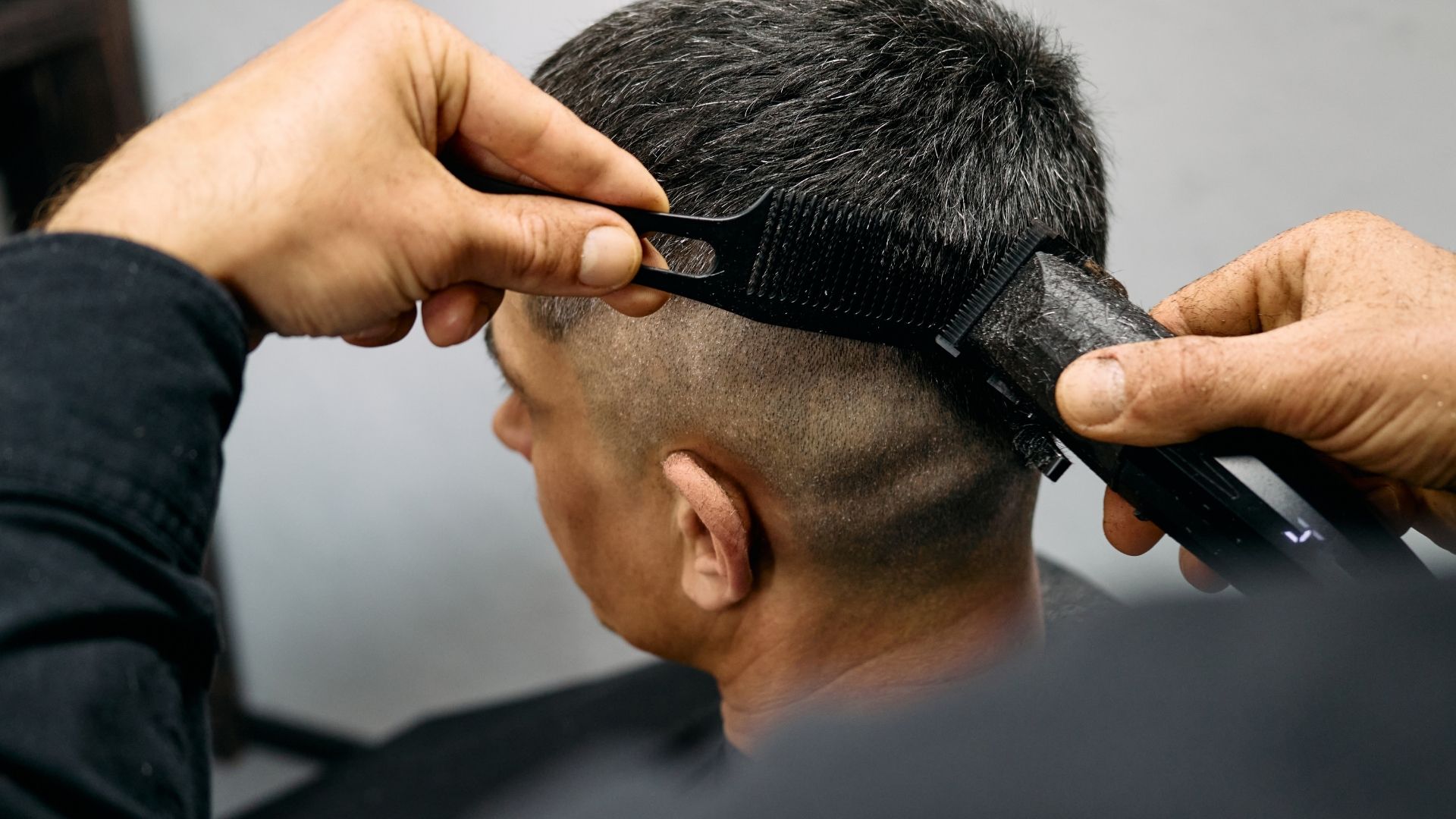
Your hair’s natural growth pattern, meaning the direction each follicle pushes hair out of your scalp, determines how a style sits, how long it lasts, and whether a fade blends or breaks. A skilled barber reads your whorls, cowlicks, crown, and neckline before the clippers ever touch your head. Ignore that map and even a perfect technique produces a cut that fights you every morning.
The Moment You Sit Down in the Chair
I’ve been cutting hair for over twenty years, and I can tell you the real work starts before a single clipper guard touches your scalp. The moment you sit down, I’m already reading you. Not your face, not your outfit, your hair. Where it swirls, where it resists, where it’s going to cause trouble three weeks from now when you’re trying to style it on a Tuesday morning without my help.
Most guys walk in with a photo on their phone and a style in mind. That’s fine. But a photo doesn’t show the direction your hair grows out of your scalp, and that direction is the single biggest variable in whether your cut looks sharp for six weeks or falls apart in six days.
Why Your Growth Pattern Is the First Thing a Good Barber Studies
Think of your scalp like a terrain map. Rivers flow downhill because gravity and geography force them that way. Your hair grows in a direction dictated by the angle of your follicles beneath the skin, and that angle was set before you were born. A barber who skips this step, who just starts cutting to a number on the clipper guard, is building a house without checking the foundation. It might look fine in the mirror under the lights, but give it a day of sleeping on it and washing it, and the whole thing shifts.
I run my fingers through dry hair first, then wet, watching where it naturally parts, where it swirls, where it stands up no matter what product you throw at it. That five-minute read tells me more about your future haircut than any photo you bring in.
What Happens When a Barber Ignores Your Natural Pattern
I’ve fixed more “bad haircuts” caused by ignored growth patterns than actual bad technique. A guy comes in with a cowlick dead center of his hairline, and his last barber gave him a hard part straight through it. Looks fine wet. By the time he’s home and it’s dried, that part has a gap you could park a motorcycle in.
Fighting your pattern means more product, more time at the mirror, and a style that looks worse with every passing day after the cut. Working with it means the opposite: a cut that actually improves as it grows out, because the shape was built around what your hair wants to do, not against it.
Setting Realistic Expectations Before the First Snip
Here’s something I tell every new client. Some growth patterns limit your options, and that’s not me being negative, that’s me being honest. A strong double crown is going to rule out certain super short buzz styles that look clean on someone with a single, well-centered crown. A pronounced cowlick at the hairline means a hard side part might never lay flat without serious product work.
That doesn’t mean you’re stuck with a boring cut. It means the best version of your haircut is the one designed specifically for your scalp, not a copy-paste of whatever’s trending on social media this month.
What Exactly Is a Hair Growth Pattern?
The Biology Behind How Hair Grows
Each hair on your head grows from a follicle, a small tube-shaped structure in your skin. The angle at which that follicle sits determines the direction the hair shaft grows. Follicles don’t grow straight up and down like grass. They tilt, and the direction of that tilt varies across different parts of your scalp. That’s why hair near your crown often grows in a spiral while hair at your nape grows mostly downward.
This isn’t random chaos either. There’s a consistent biological logic to it, formed during fetal development and locked in for life (barring certain medical changes we’ll get into later).
Follicle Direction and Why It Varies Across Your Scalp
Your scalp isn’t one uniform surface. It has distinct zones, and each one tends to have its own general flow direction:
| Scalp Zone | Typical Growth Direction |
| Crown | Spirals outward from a central point (whorl) |
| Hairline/Forehead | Forward and slightly downward |
| Temples | Angled back toward the ears |
| Sides | Generally downward toward the neck |
| Nape/Neckline | Downward, sometimes with upward cowlicks |
| Part Line Areas | Varies, often splits left or right naturally |
A good barber treats this chart like a weather forecast. It tells you what to expect in each zone, but every head has its own local conditions worth checking individually.
The Difference Between Growth Pattern, Hair Texture, and Hair Type
These three terms get mixed up constantly, and they’re not the same thing.
Growth pattern is the direction your hair grows out of the scalp. Hair texture refers to the shape of the hair strand itself, meaning whether it’s straight, wavy, curly, or coily. Hair type typically refers to the thickness and density of your hair overall, such as fine, medium, or thick.
You can have straight hair texture with a chaotic growth pattern, and you can have curly hair texture with a relatively simple growth pattern. All three factors combine to determine your final cut, but growth pattern is often the one that gets overlooked, because it’s harder to see with the naked eye until the hair is already cut and drying.
Whorls, Cowlicks, and Crowns — The Big Three

Understanding Hair Whorls and Where They Show Up
A whorl is a spiral growth pattern, most commonly found at the crown but occasionally showing up elsewhere on the scalp. Picture water draining from a sink. That spiral shape is essentially what’s happening with your hair follicles in a whorl zone.
Whorls can rotate clockwise or counterclockwise, and interestingly, research on hair whorl direction has suggested a link to handedness in some populations, though it’s not an absolute rule. What matters for your haircut is simpler: the direction your whorl spins affects how hair lays once it grows past a certain length, and a barber needs to cut with that spin, not against it.
Cowlicks — What They Are and Why They Fight Every Style
A cowlick is a small section of hair that grows in a different direction from the surrounding hair, usually standing more upright or pointing a different way entirely. Most commonly found at the front hairline, cowlicks are notorious for ruining an otherwise clean part or fringe.
If you’ve ever had a piece of hair that just won’t lay down no matter how much product you use, that’s almost certainly a cowlick. The name comes from the old belief that the spot looked like it had been licked by a cow’s rough tongue, which, honestly, once you picture it, makes a strange kind of sense.
The Crown: Where Most Haircuts Win or Lose
The crown is the highest point of the back of your head, and it’s ground zero for growth pattern complications. Because hair radiates outward from a central point here, cutting it too short often makes the scalp visible in a way that looks patchy rather than intentional, especially with thinner hair.
I tell clients the crown is where a haircut either reads as deliberate or looks like an accident. A barber who blends length gradually into and out of the crown zone, respecting that radial growth, gets a result that looks tailored. Cut straight across it with no adjustment, and you’ll see gaps and flat spots within a week.
Double Crowns and What That Means for Your Cut
Some guys have two whorls instead of one, known as a double crown. This creates a more complex growth pattern where hair pushes outward from two separate points, sometimes clashing in the middle.
Double crowns are more challenging to work with, particularly for very short styles like buzz cuts, where there’s less length available to blend the conflicting directions. If you’ve got one, your barber needs to know before the clippers come out, because the guard length that works beautifully for a single crown might expose both whorls and create an uneven, patchy look on a double.
Hairline Shape and How It Shapes Your Entire Look
Natural Hairline Types (Straight, Rounded, Widows Peak, Receding)
| Hairline Type | Description | Common Styling Approach |
| Straight | Runs nearly level across the forehead | Works well with blunt fringes, structured fades |
| Rounded | Curves gently at the temples | Softer textured styles complement the curve |
| Widow’s Peak | A V-shaped point at the center hairline | Styles that incorporate or minimize the point |
| Receding | Hairline moving back at the temples | Shorter styles, strategic forward texture |
| Uneven | Asymmetrical shape across the forehead | Custom shaping to balance visual symmetry |
How Your Hairline Affects Which Styles Actually Work for You
Your hairline is the frame around your face, and it interacts directly with your growth pattern. A widow’s peak combined with a strong forward-growing cowlick, for example, can make certain fringe styles nearly impossible to maintain without daily product work. On the flip side, that same widow’s peak can look sharp with a textured crop that uses the point as a design feature rather than fighting to hide it.
A rounded hairline generally gives you more flexibility, since there’s no sharp angle to work around. A straight hairline pairs beautifully with clean, architectural cuts like a classic taper, because there’s a crisp line for the barber to build the shape against.
Working With a Receding Hairline Instead of Against It
A receding hairline is one of the areas I see men fight the hardest, usually because they’re trying to recreate a style from when their hairline sat differently. Here’s the straight talk: trying to style longer hair forward to cover a receding hairline almost always looks worse than embracing a shorter, tighter cut that works with where your hairline actually sits today.
A buzz cut, crew cut, or tight fade draws attention away from the recession and toward a clean, intentional silhouette. It’s not about hiding anything. It’s about building a cut around your current reality instead of a photo from five years ago.
Hair Texture’s Role in How Growth Patterns Behave
Straight Hair vs. Wavy Hair — How Growth Patterns Behave Differently
Straight hair shows growth pattern problems more visibly, because there’s no natural wave to disguise a wonky section. A cowlick on straight hair stands out like a flagpole. On wavy hair, the same cowlick often gets absorbed into the surrounding wave pattern and barely registers.
That said, straight hair is generally easier for a barber to predict, because it behaves consistently once you know the direction it’s growing. Wavy hair can shift direction slightly depending on humidity, product, and even how you slept the night before, which makes consultation even more important.
Curly and Coily Hair: Growth Patterns Are Amplified
With curly and coily hair textures, growth patterns are often more pronounced because the natural curl pattern interacts with the follicle angle to create volume and movement that straight hair simply doesn’t have. A whorl at the crown on coily hair can create a dramatic burst of volume if not shaped correctly, while that same whorl on straight hair might barely be noticeable.
Barbers working with curly and coily textures need to think in three dimensions, since the growth direction and the curl shape both affect the final silhouette, not just the length.
Thick vs. Fine Hair: How Density Changes the Game
| Factor | Thick Hair | Fine Hair |
| Visibility of growth pattern issues | Less visible, more hair to blend with | Highly visible, scalp shows through gaps |
| Styling product needs | Stronger hold products needed | Lighter products, less is more |
| Ideal fade compatibility | Handles aggressive fades well | Needs softer blending to avoid patchiness |
| Cowlick management | Easier to disguise with surrounding volume | Cowlicks stand out more prominently |
The Neckline — Where Growth Patterns Are Most Unforgiving
Natural Neckline Growth Directions and Why They Matter
Your neckline is the boundary where your haircut ends and your neck begins, and it’s one of the most unforgiving zones when it comes to growth pattern. Hair at the nape often grows in multiple directions at once, sometimes swirling, sometimes growing straight down, occasionally shooting upward in a stubborn cowlick right at the base of the skull.
How to Get a Clean Neckline That Lasts Longer
A Clean Neckline isn’t just about running the clippers along your natural hairline at the back of your neck. It’s about reading the direction of growth in that zone and cutting with it, not against it, so the line stays crisp as the hair starts growing back in the days following your cut. A neckline cut against the grain might look sharp the moment you leave the chair, but it’ll look ragged within a week because the regrowth pattern fights the shape you just cut.
Tapered vs. Blocked Necklines and How Growth Pattern Decides
A tapered neckline gradually fades the hair shorter as it approaches the natural hairline, blending seamlessly into the skin. A blocked neckline, by contrast, cuts a hard, straight line regardless of the natural curve of the hairline.
Tapered necklines work better on necks with irregular or swirling growth patterns, because the gradual blend hides inconsistencies. Blocked necklines demand a relatively uniform, downward growth pattern to look clean, since any cowlicks or swirls in that zone will show as notches or gaps along the hard line. If you’ve got a stubborn swirl at your nape, ask your barber for a taper. Your future self, three weeks post-cut, will thank you.
Reading the Map — How Barbers Analyze Your Scalp
The Pre-Cut Consultation: What Your Barber Is Really Looking For
A real consultation isn’t small talk while the cape gets fastened around your neck. I’m checking your crown for single or double whorls, running a comb against the grain near your hairline to spot cowlicks, and asking you how your hair typically behaves on day three or four after a cut, since that tells me how the growth pattern asserts itself once the fresh cut starts growing out.
Tools Barbers Use to Understand Growth Patterns
Most of this comes down to hands, a comb, and two decades of pattern recognition, but a few tools help:
| Tool | Purpose |
| Fine-tooth comb | Reveals part lines and resistance points |
| Water spray bottle | Shows true growth direction when hair is wet and flat |
| Hand-held mirror | Lets the client see crown and nape patterns themselves |
| Clipper-over-comb technique | Tests how hair falls once shortened |
Why Wet vs. Dry Assessment Changes Everything
| Assessment Method | What It Reveals | Best Used For |
| Dry Assessment | True resting direction, natural volume, cowlick severity | Determining final style and part location |
| Wet Assessment | Flattened growth direction, exact follicle angle | Precision cutting lines, neckline, and fades |
I check both. Wet hair lies flat and shows the raw direction of the follicles, which is great for cutting precise lines. But dry hair shows how the cut will actually behave day to day, which is what you’re going to be looking at in the mirror every morning.
Popular Haircut Styles and How Growth Patterns Affect Each One
The Fade — How Growth Patterns Impact Blending
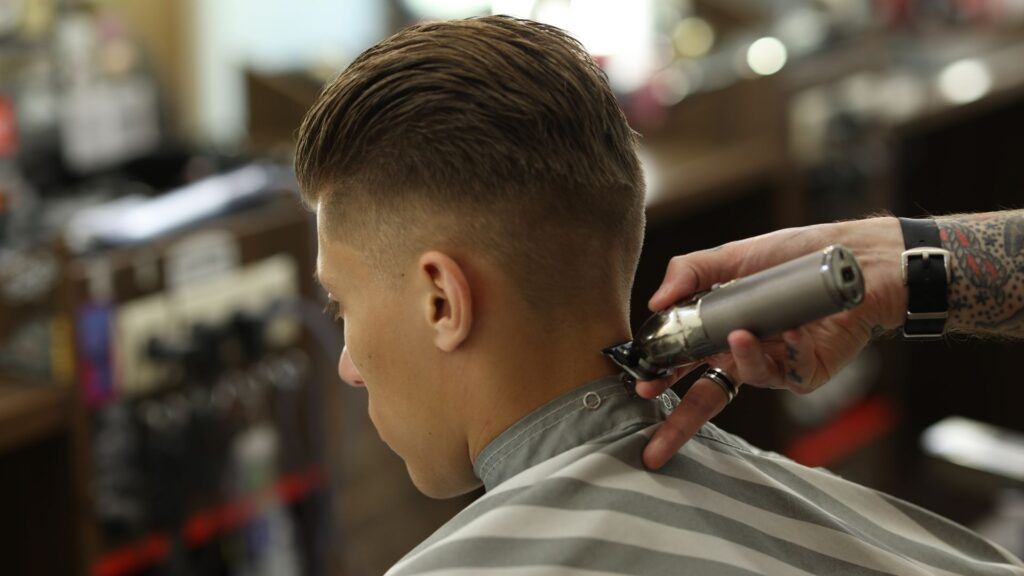
A fade relies on a seamless transition from skin to length, and growth pattern plays a massive role in how well that transition reads. A whorl near the temple can create a visible interruption in an otherwise smooth fade if the barber doesn’t adjust the blending angle specifically for that spot.
The Classic Taper and Growth Pattern Compatibility
A taper is more forgiving than a fade because it maintains more length overall, giving the barber more room to work around growth pattern quirks. If you’ve got a complicated crown or a cowlick-heavy hairline, a taper often gives better, longer-lasting results than an aggressive skin fade.
Textured Crops, Quiffs, and Pompadours
These styles actually benefit from certain growth patterns. A natural forward-growing section at the crown can enhance the lift needed for a quiff or pompadour, meaning you might need less product than someone whose hair grows flat against the scalp in that zone.
The Buzz Cut — The One Style Where Pattern Still Matters
People assume a buzz cut eliminates growth pattern concerns entirely, since there’s barely any length to style. Wrong. Even at a quarter inch, a double crown or strong whorl will show as a visible spiral or thin patch, because there’s no length left to blend the conflicting directions. A good barber adjusts the guard length slightly in those zones to compensate.
Comparing Styles Head to Head
To make the decision-making easier, here’s how some of the most requested styles stack up against common growth pattern challenges.
Fade vs. Taper: Choose a fade if your growth pattern is relatively uniform and you want a sharp, high-contrast look. Choose a taper if you’ve got a double crown, strong cowlicks, or an irregular hairline, since the extra length gives more room to blend problem areas.
Tapered Neckline vs. Blocked Neckline: Choose a tapered neckline if your nape has swirling or multidirectional growth. Choose a blocked neckline only if your natural growth at the nape runs consistently downward with no major cowlicks.
Wet Assessment vs. Dry Assessment: Wet assessment is for precision lines like necklines and fade boundaries. Dry assessment is for understanding real-world styling behavior and choosing the overall shape.
Straight Hair vs. Wavy Hair for Pattern Visibility: Straight hair shows growth pattern flaws more clearly and needs more careful cutting around cowlicks. Wavy hair naturally disguises minor pattern irregularities, giving you more styling flexibility.
Single Crown vs. Double Crown: A single crown handles short buzz cuts and skin fades well. A double crown generally needs slightly more length retained at the crown to blend both whorls smoothly.
Working With a Receding Hairline vs. Styling Against It: Working with it means shorter, tighter cuts that look intentional. Styling against it, meaning growing hair longer to comb over the recession, typically looks less natural and requires far more daily maintenance.
Buzz Cut vs. Textured Crop for a Strong Cowlick: A buzz cut exposes a strong cowlick with almost nothing to disguise it. A textured crop gives enough length for the barber to redirect and blend the cowlick into the surrounding style.
Short-Term Stylist Visits vs. a Long-Term Barber Relationship: A one-off stylist visit means re-explaining your growth pattern every single time. A long-term barber relationship means your barber already knows your crown, your cowlicks, and your neckline before you even sit down, which consistently produces better, faster results.
Common Mistakes Men Make When They Fight Their Growth Pattern
Choosing a Style That Contradicts Your Natural Flow
The number one mistake I see is guys choosing a style purely off a photo without any regard for whether their own growth pattern can actually support it. A hard side part looks incredible on a guy with cooperative hair. On a guy with a front cowlick, that same part becomes a daily battle.
Over-Styling and Product Overload
When a cut doesn’t respect the growth pattern, the natural response is to pile on more pomade, more gel, more hairspray, trying to force compliance. This usually backfires, leaving hair looking stiff, greasy, or simply collapsed by midday.
Going Too Short Too Fast
Dropping several guard lengths in one visit without checking how your scalp’s growth pattern behaves at that shorter length is a recipe for patchy, uneven results, especially around the crown and any cowlick zones.
Not Telling Your Barber About Problem Areas
If you know you’ve got a stubborn cowlick or a section that never lays flat, say something. We can’t read your styling history from across the cape. A thirty-second comment saves everyone a frustrating appointment.
Maintenance Between Cuts and How Growth Pattern Affects Upkeep
How Fast Hair Grows and Why Pattern Makes It More Noticeable
Hair grows at roughly half an inch per month on average, though this varies by individual. Growth pattern doesn’t change your growth rate, but it does change how noticeable that growth is. A cowlick-heavy section will start asserting itself again within a week or two, while a uniform-growth area can stay neat for the full six-week stretch.
Touch-Up Frequency Based on Pattern and Style
| Style | Standard Touch-Up Frequency | Faster If Strong Growth Pattern Issues |
| Skin Fade | Every 2 to 3 weeks | Every 1 to 2 weeks |
| Taper | Every 3 to 4 weeks | Every 2 to 3 weeks |
| Textured Crop | Every 4 to 6 weeks | Every 3 to 4 weeks |
| Buzz Cut | Every 2 to 3 weeks | Every 1 to 2 weeks |
Daily Styling Techniques That Work With Your Pattern
Dry your hair in the direction it naturally grows before applying product, not against it. Fighting the direction with a blow dryer only gives you temporary results that collapse within a few hours. Apply product to damp, not soaking wet, hair, and work it in the direction of growth first before adjusting for your desired style.
Growth Patterns Across Different Hair Types and Ethnicities
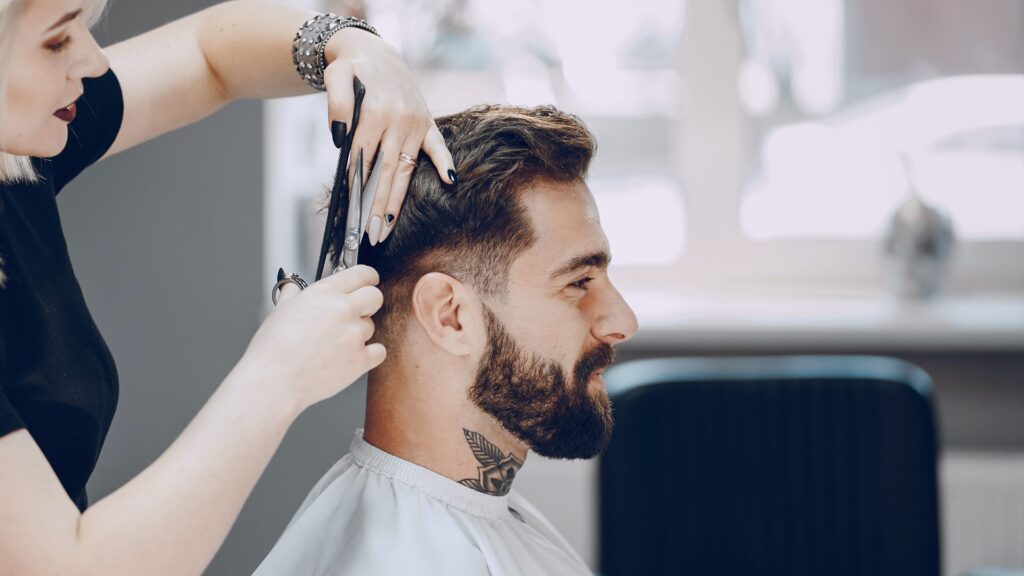
Growth Patterns in Black and Mixed-Race Hair
Coily and tightly curled hair textures, common among Black and mixed-race clients, often have growth patterns that interact strongly with the curl pattern itself, creating natural volume and shape that straighter hair textures don’t produce. Fades and tapers on coily hair require careful attention to how the curl springs back after cutting, since the cut length can look different once the hair dries and curls up compared to how it looked wet.
Growth Patterns in Asian Hair
Asian hair textures are frequently coarser and straighter, which tends to make growth pattern irregularities, like cowlicks, especially visible due to the hair’s tendency to hold its shape rigidly rather than softening into a wave.
Growth Patterns in Caucasian and Latino Hair
These textures vary enormously from straight to curly, and growth pattern behavior varies right along with it. Generally speaking, finer Caucasian hair textures show pattern issues more readily, since there’s less volume to disguise an irregular section.
| Hair Background | Common Growth Pattern Tendency | Styling Consideration |
| Black/Mixed-Race, Coily | Strong interaction between curl and growth direction | Account for shrinkage when cutting length |
| Asian, Coarse Straight | Cowlicks very visible due to rigidity | Precision cutting around cowlick zones |
| Caucasian, Fine to Medium | Pattern issues show through thinner density | Softer blending techniques recommended |
| Latino, Wavy to Curly | Growth pattern often absorbed into wave | More flexibility in style choice |
When Your Growth Pattern Changes Over Time
How Age Affects Hair Growth Direction
Your core growth pattern, meaning the direction your follicles point, is largely set for life. What does change with age is density and texture, which can make existing patterns more or less noticeable. Thinning hair at the crown, for example, makes a whorl far more visible than it was when you had a full head of thick hair in your twenties.
Hormonal Changes, Stress, and Pattern Shifts
Hormonal shifts and prolonged stress can affect hair density and, in some cases, texture, which indirectly changes how your existing growth pattern presents itself. A whorl that was easily hidden under thick hair can suddenly become a focal point once density drops.
Post-Surgery and Medical Treatment Effects on Growth
Scalp surgery or certain medical treatments can, in some cases, alter hair growth direction in the affected area as new follicles form during healing. If you’ve had any procedure involving your scalp, let your barber know, since the growth pattern in that specific zone may behave differently than the rest of your head.
Choosing the Right Barber for Your Pattern — What to Look For
Questions to Ask Before You Book
Ask whether they do a hands-on consultation before cutting, whether they check both wet and dry hair, and whether they’re comfortable explaining why a certain style will or won’t work with your specific growth pattern. A barber who can answer these confidently is one who understands the craft beyond just running clippers on autopilot.
Red Flags That Tell You a Barber Doesn’t Understand Growth Patterns
Watch out for a barber who never touches or examines your hair before cutting, who recommends the exact same style to every client regardless of their head, or who seems annoyed when you mention a cowlick or problem area. These are signs of someone executing a technique rather than reading your individual scalp.
The Value of a Long-Term Barber Relationship
There’s real value in sticking with one barber over time. After a few visits, your barber builds a mental map of your crown, your cowlicks, your neckline, and your hairline. Every future appointment gets faster and more precise because of it. This is one of the biggest reasons guys searching “haircut near me” after moving to a new city often feel like their first few cuts never quite land the way their old barber’s did. It takes a visit or two for a new barber to properly read your pattern.
The Cost Factor — Does Working With Your Pattern Save Money?
How Ignoring Your Pattern Costs You More Over Time
A cut that fights your natural growth pattern often needs more frequent touch-ups to stay presentable, plus more styling product to force compliance day to day. Over a year, that adds up in both time and money.
Pricing Differences for Complex Pattern Work
| Service Complexity | Typical Time Added | Potential Price Impact |
| Standard cut, simple pattern | Baseline | Standard pricing |
| Double crown blending | 10 to 15 extra minutes | Minor upcharge at some shops |
| Multiple cowlick management | 10 to 20 extra minutes | Minor upcharge at some shops |
| Complex neckline/hairline work | 5 to 10 extra minutes | Usually included in standard price |
Budget Planning Around Your Hair Maintenance Needs
| Style Choice | Monthly Visits | Estimated Monthly Product Spend |
| Low-maintenance buzz/crew cut | 1 to 2 | Low |
| Moderate taper/fade | 1 to 2 | Moderate |
| High-maintenance styled crop | 1 | Moderate to High |
Choosing a style that works with your growth pattern instead of against it is one of the simplest ways to keep both your grooming budget and your weekday mornings under control.
FAQ — Your Growth Pattern Questions Answered
Can I train my hair to grow in a different direction?
Not in any permanent sense. Your follicle angle is set beneath the skin and doesn’t change through brushing or product use. You can temporarily redirect hair with styling, heat, or product, but it will return to its natural direction once washed.
Why does my cowlick always come back no matter what?
Because a cowlick is a structural feature of your follicle direction, not a surface-level styling issue. Product and heat offer temporary control, but the underlying growth direction reasserts itself as soon as the styling wears off.
What is the best haircut for a double crown?
Styles that retain a bit more length at the crown, like a taper or textured crop, generally blend double crowns more successfully than ultra-short buzz cuts, which expose both whorls with little length to disguise them.
How do I describe my growth pattern to my barber?
Point out any areas that consistently refuse to lay flat, mention if you have a cowlick at your hairline or nape, and let them know if your crown has ever looked patchy with shorter cuts. This gives your barber real information to work with beyond what they can see at first glance.
Does hair growth pattern affect how fast my hair looks untidy?
Yes. Sections with strong cowlicks or irregular growth tend to show regrowth and disarray faster than areas with uniform growth, since even a small amount of new length is enough to disrupt the cut shape in those zones.
Can a fade work with a strong cowlick?
It can, but it requires a skilled barber who adjusts the blending angle specifically around the cowlick zone. A less experienced barber may produce a fade with a visible interruption or notch where the cowlick sits.
Is there a haircut that works for every growth pattern?
Not exactly, but a well-executed taper comes close, since it offers enough length to blend most growth pattern irregularities while still looking clean and structured. The specific adjustments still need to be tailored to your individual scalp.
Your Action Plan — Working With Your Pattern Starting Today
Step-by-Step Pre-Appointment Checklist
- Note any cowlick locations you’re aware of, especially at the hairline and neckline
- Check whether you have a single or double crown by parting your hair at the top and looking in a mirror
- Identify your hairline shape (straight, rounded, widow’s peak, or receding)
- Bring a reference photo, but stay open to adjustments based on your barber’s assessment
- Mention how your hair typically behaves three to five days after a cut
How to Track Your Growth Pattern Over Multiple Cuts
Keep a simple note on your phone after each cut describing what worked and what didn’t. Did the neckline hold its shape for the full six weeks? Did a particular section need extra product? This record becomes incredibly useful information, whether you’re sticking with the same barber or trying someone new.
Building a Style Around What Your Hair Naturally Wants to Do
The best-looking cuts I’ve ever given weren’t the most complicated ones. They were the ones where I took fifteen extra seconds to really look at how a guy’s hair wanted to move, and built the shape from there instead of forcing a trend onto a scalp that wasn’t built for it.
The Last Word From the Chair
Twenty years behind the chair has taught me one consistent truth. The haircut that gets the most compliments, that holds its shape the longest, and that takes the least effort to style every morning is always the one built around your natural growth pattern, not against it. There’s no shortcut around this. Good barbering is pattern reading first, technique second. A cowlick isn’t a flaw to eliminate. A double crown isn’t bad luck. These are simply the unique architecture of your head, and a skilled barber treats them as design elements rather than obstacles. Some of the most distinctive, memorable cuts I’ve given worked specifically because they leaned into a quirky growth pattern instead of trying to erase it.If you take one thing from everything above, let it be this: find a barber who touches your hair, asks real questions, and explains the “why” behind their recommendations. That relationship, built visit after visit, is worth far more than any single trendy style. Your hair has a natural direction. The right barber simply knows how to listen to it.