
Fourteen Days Tells the Truth
The Man Who Came Back Smiling
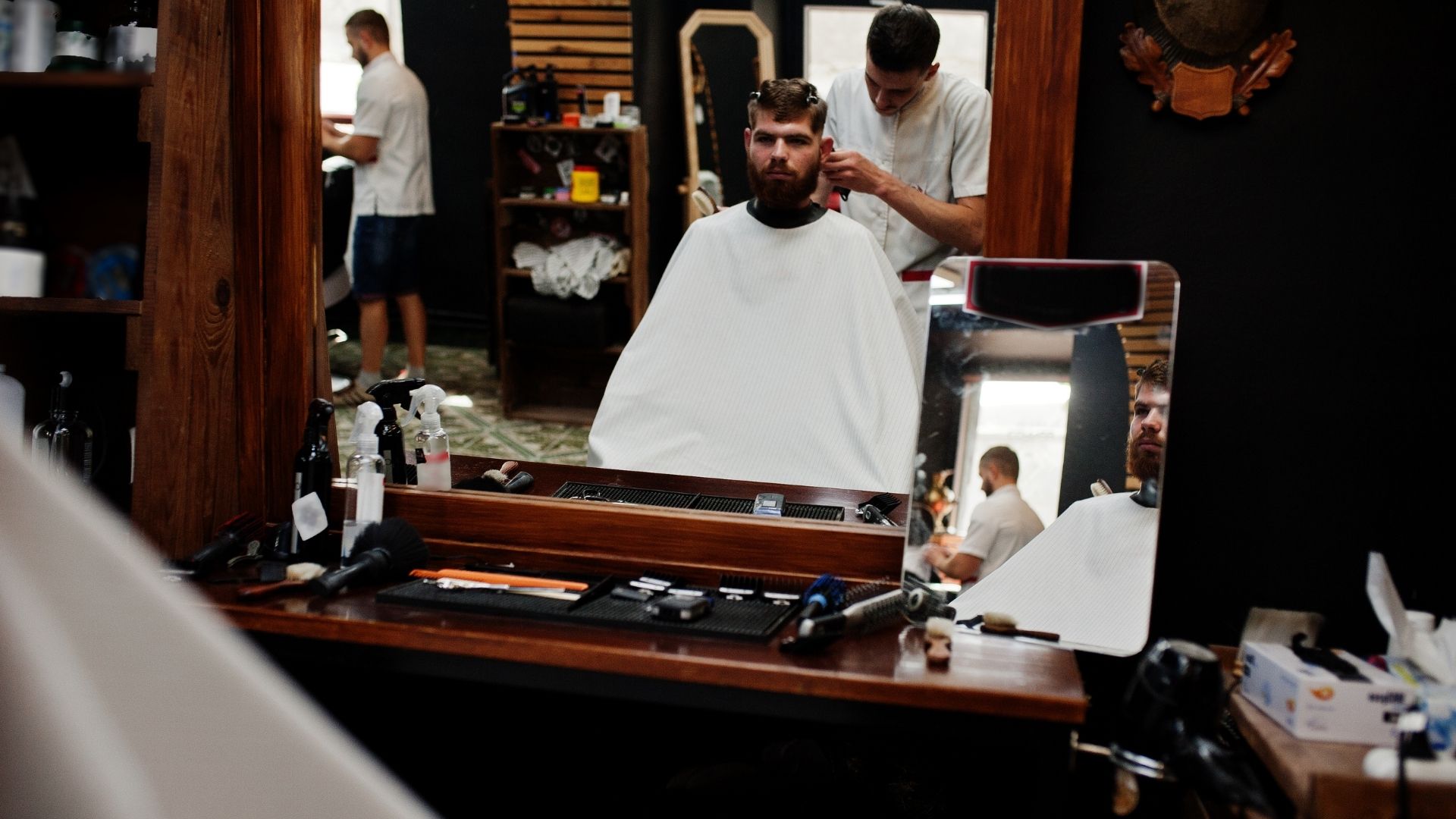
Marcus first sat in my chair on a rainy Thursday. He was a contractor with sawdust still on his boots. Right away he told me he’d had three different barbers in three months, and none of them had “gotten it right.”
I asked him what “right” looked like.
He thought about it for a moment while I snapped the cape around his neck. “It looks great when I leave,” he said. “Then about ten days later, it looks like I cut it myself in a truck mirror.”
That sentence stuck with me. He wasn’t unhappy with the haircut. He was unhappy with how it aged.
So we built his cut a little differently. I kept the fade a touch lower, left more weight over a flat spot at the back of his head, and softened his neckline into a taper instead of a hard block. When he left, it looked good. Not dramatic. Just good.
Two weeks later he walked back in, and he wasn’t there for a cut. He’d stopped by to pay for his buddy’s appointment. He pointed at his own head and grinned. “Still looks like a haircut,” he said. “That’s new.”
I’ve thought about Marcus many times since. Perhaps he taught me more than I taught him. He reminded me that a cut doesn’t live in the chair. It lives in your bathroom mirror, your work meetings, your kid’s soccer games, and your Tuesday mornings when you’re running late.
Why Day One Can Fool You
There’s something a little magical about the moment you stand up from the chair. The hot towel has just come off your neck. The talc is still dusted across your collar. The edges are crisp, the product is fresh, and your barber spins you around with the hand mirror so you can admire the back.
Almost every cut looks good at that moment.
I noticed long ago that day one is a bit like a brand-new car on the dealer’s lot. It’s washed, waxed, and parked under perfect lights. You don’t really know what you’ve bought until you’ve driven it through a few rainstorms.
A haircut on day one hides several things:
- Fresh edges cover uneven growth patterns underneath
- Styling product holds hair in place that might not sit there naturally
- Skin-short areas haven’t started to show their real shape
- Blow-drying lifts and positions hair in ways you might not repeat at home
None of this is dishonest. It’s simply that a freshly finished cut is at its peak. The question worth asking is how it behaves on the way down.
What the Two-Week Rule Actually Is
The two-week rule is a simple idea: judge your haircut at the fourteen-day mark, not the day you get it.
By two weeks, the cut has had time to grow, settle, get washed a dozen times, and live through your actual routine. Short areas have grown enough to reveal their true shape. Any hidden mistakes, like a weight line in the wrong place or uneven blending, have had time to surface.
It seems to me that two weeks is the sweet spot for three reasons:
- It’s long enough for hair to grow roughly a quarter inch, which exposes the structure underneath
- It’s short enough that a well-built cut should still look intentional
- It’s practical, because it falls about halfway through the typical three-to-four-week cycle most men follow
Think of it like a coach reviewing game film. The final score tells you something, but watching the second quarter tells you far more about how the team actually plays.
To understand why two weeks reveals so much, it helps to look at what’s happening under the skin.
What Happens Under the Cut: The Science of Growth
Half an Inch a Month, Give or Take
According to the American Academy of Dermatology, scalp hair grows about six inches per year. That works out to roughly half an inch a month, or a little over a third of a millimeter every day.
Those numbers sound tiny. On a long scissor cut, they barely register. But on a skin fade, they change everything.
| Days After the Cut | Approximate Growth | What a Skin Fade Starts to Resemble |
| Day 3 | About 1.3 mm (1/16 inch) | A light shadow |
| Day 7 | About 3 mm (1/8 inch) | A #1 guard |
| Day 14 | About 6 mm (1/4 inch) | A #2 guard |
| Day 21 | About 9 mm (3/8 inch) | A #3 guard |
| Day 28 | About 12 to 13 mm (1/2 inch) | A #4 guard |
Look at day fourteen. The skin-short area at the bottom of your fade now holds as much hair as a #2 guard leaves behind. That’s not a small shift. It’s a whole new haircut growing in underneath the old one.
This is why I always tell clients that a fade isn’t one cut. It’s a moving gradient that changes shape every single day.
Anagen, Catagen and Telogen
Every hair on your head cycles through three main phases. Dermatologists, including those at the Cleveland Clinic, describe them like this:
| Phase | What Happens | Typical Length | Share of Scalp Hair |
| Anagen | Active growth | 2 to 7 years | About 85 to 90 percent |
| Catagen | Growth slows, follicle shrinks | About 2 to 3 weeks | Around 1 percent |
| Telogen | Resting, then shedding | About 3 months | Roughly 10 to 15 percent |
The American Academy of Dermatology notes that most people shed between 50 and 100 hairs a day. That’s normal. It’s the telogen hairs finishing their run.
Why does this matter for your cut? Because not every hair in a given patch is growing at the same moment. Some are sprinting. Some are resting. Over two weeks, that mix creates tiny differences in length that can make a section look a little less even than it did on day one.
Why Every Hair Keeps Its Own Clock
Growth speed isn’t the same for everyone, or even across one head. A study by Geneviève Loussouarn and colleagues, published in the British Journal of Dermatology, measured growth rates across different hair types and found that tightly coiled African hair grew at roughly 0.26 mm per day, while Caucasian and Asian hair grew noticeably faster, closer to 0.4 mm per day.
I’ve seen this play out behind the chair for decades. Two men can leave with the same skin fade on the same afternoon, and at day fourteen, one looks freshly faded while the other looks like he’s ready for a cleanup.
Growth can also vary by area. Many men notice their sides and nape seem to fill in faster than the top. Part of that is perception, since short hair shows growth more clearly, and part of it is simply the individual rhythm of each follicle.
Perhaps the takeaway is this: your two-week check isn’t about comparing your head to anyone else’s. It’s about comparing your cut to itself.
Knowing how hair grows is one piece. Knowing how men have timed their cuts through the years adds another.
Where the Rule Came From
The Saturday Trim and the Weekly Shave
When I was a young apprentice, the old-timers in the shop where I trained told stories about men who came in every Saturday. Some came for a shave. Some came for a quick trim around the ears. Many came just to sit, read the paper, and argue about baseball.
In the early and mid-1900s, the neighborhood barbershop was a weekly ritual for a lot of American men. Hair was cut short and neat, and keeping it that way meant frequent visits. The two-week mark wasn’t really a “rule” back then. It was just part of the rhythm of life, like mowing the lawn or polishing your shoes for church.
I still remember the smell of those old shops: bay rum, hot lather, leather strops hanging from the chair, and that faint powdery sweetness of talc in the air. Men didn’t judge their cuts at fourteen days because they rarely let them get that far.
The Fade Changed the Clock
Then the fade arrived, and the clock changed.
| Era | Popular Style | Typical Visit Rhythm | How Grow-Out Was Judged |
| 1920s to 1940s | Short back and sides | Weekly to biweekly | Neatness around ears and collar |
| 1950s | Flattop, crew cut | Every 1 to 2 weeks | Flatness and squareness of the top |
| 1960s to 1970s | Longer, shaggier styles | Every 6 to 8 weeks | Overall shape, not edges |
| 1980s to 1990s | Hi-top fade, early skin fades | Every 1 to 3 weeks | Sharpness of the fade and outline |
| 2000s | Low-maintenance crops | Every 3 to 5 weeks | Overall tidiness |
| 2010s | Skin fades, undercuts | Every 2 to 3 weeks | Smoothness of the gradient |
| 2020s | Softer fades, textured crops, mullets | Every 3 to 5 weeks | How gracefully the shape grows |
When the long, loose styles of the late 1960s and 1970s took over, many men stretched their visits to six weeks or more. Then the fade came roaring back through the 1980s and 1990s, especially in Black barbering culture, where precision blending became an art form. Suddenly, a few days of growth mattered again.
It seems the two-week rule grew out of fade culture. When your cut depends on millimeters, you start paying close attention to how fast those millimeters disappear.
From Appointment Cards to Booking Apps
For decades, barbers handed out little paper appointment cards with the next date scribbled in pen. Many men tucked them into their wallets and forgot about them until they found them months later, soft and faded, next to an old lottery ticket.
Online booking changed that. Now you can schedule your next visit before you’ve even brushed the hair off your neck. Many shops send reminders automatically.
I noticed that this convenience has a quiet side effect. Men are thinking more about timing than they used to. They’re asking, “When should I come back?” instead of “When does it look bad enough?” And the two-week mark has become a natural moment to pause and ask whether the cut is aging well.
So what exactly should you be looking for when that moment arrives?
Day One vs. Day Fourteen: What Should Change and What Shouldn’t

What Is Supposed to Soften
Some changes are perfectly normal. In fact, if these didn’t happen, I’d be a little worried.
By day fourteen, you can expect:
- The fade to darken. The skin-short areas will have grown in, so the gradient looks shorter and less dramatic.
- The edges to blur. A crisp neckline and sharp temples will have softened with new growth.
- The ears to look a little fuller around the edges. Hair grows around them and starts touching the tops.
- The top to lose a little of its lift. As it grows heavier, it may lie down more easily.
These changes are like the tan lines fading after summer vacation. They’re expected. They don’t mean anything went wrong.
What Should Hold Firm
Other things shouldn’t change much, even at two weeks. These are the bones of the haircut, the structure your barber built.
- The overall silhouette. From a few feet away, the shape of your head should look about the same as day one.
- Balance between sides. If your left and right sides matched on day one, they should still match.
- The weight line placement. Where the short sides meet the longer top should still sit in a flattering spot.
- How the top behaves. If you could style it easily on day three, you should still be able to style it on day fourteen.
A well-built cut is like a well-built house. The paint might fade and the lawn might grow, but the walls stay straight.
Growing Out vs. Falling Apart
This is perhaps the most important comparison in the whole blog. There’s a big difference between a cut that’s growing out naturally and one that’s falling apart.
| Factor | Growing Out Well | Falling Apart |
| Silhouette | Same shape, just fuller | Shape has changed or bulged |
| Sides | Evenly filled in | One side noticeably fuller |
| Back | Still rounded | Shelf, dent or hump appears |
| Top | Styles as before | Won’t sit, sticks out, flops |
| Neckline | Soft and natural | Crooked or patchy |
| Weight line | Blended, gently visible | Harsh, obvious step |
| Your feeling | “Needs a cleanup soon” | “Something is wrong” |
That last row matters more than you might think. I’ve noticed that men often sense the difference before they can explain it. A cut growing out well feels like an old friend who needs a shave. A cut falling apart feels like a stranger wearing your clothes.
Now let’s walk through what those fourteen days usually look like, one stretch at a time.
A Day-by-Day Map of the First Two Weeks
Days 1 to 3: The Settling Period
The first few days are about settling. Your hair has just been cut, possibly blow-dried, and styled with product. It needs a few washes to find its natural fall.
During these days, you might notice:
- The top feels a little stiff or “new”
- Some sections stick up where they were cut shortest
- Your skin feels tender if you had a skin fade or straight-razor outline
- The style looks slightly different when you do it yourself
This is a bit like breaking in a new pair of leather boots. They feel stiff at first, and then they start to shape around you. I usually tell clients not to judge anything until they’ve washed and styled it themselves at least twice.
Days 4 to 7: The Honest Week
Somewhere around day four, the cut starts telling the truth. The product has washed out. The blow-dry lift is gone. Your hair is doing what it naturally wants to do.
This is when you’ll first spot your growth patterns. A cowlick at the crown might start lifting. Hair around the ears might start to curl outward. The sharp edges of your outline will have a soft shadow.
It seems to me that this stretch reveals how well the cut matches your natural hair, while the next stretch reveals how well it matches your head shape.
Days 8 to 11: The Shape Shows Its Bones
By the second week, enough growth has arrived to show the real structure. On a fade, the blend is now darker and the transitions are clearer. On a scissor cut, the weight has started to shift.
| Days | What You’ll Notice | What It Tells You |
| 1 to 3 | Stiffness, fresh edges, product hold | Very little about the cut’s quality |
| 4 to 7 | Natural fall, growth patterns appear | How well the cut matches your hair |
| 8 to 11 | Blend darkens, weight shifts | How well the cut matches your head shape |
| 12 to 14 | Full structure visible | Whether the cut was built to last |
This is where a poorly placed weight line starts to look like a ridge. It’s also where a well-placed one quietly does its job without drawing attention.
Days 12 to 14: Judgment Day
By the end of the second week, you’ve lived with the cut. You’ve slept on it, sweated in it, worn a hat over it, and washed it more than a dozen times.
This is the moment to ask yourself a simple question: does this still look like a haircut, or does it look like hair?
That’s not a trick question. A cut that’s aging well still has visible intention. You can see the shape your barber built. A cut that’s falling apart has lost that intention, and it simply looks like hair growing wherever it wants.
So how do you actually check, especially the parts you can’t see?
How to Run Your Own Two-Week Check
Set Up Your Mirrors and Your Light
Most men judge their haircut in a bathroom mirror under a single overhead bulb. That’s a bit like judging a used car in a dark parking garage.
Here’s a simple setup that works:
- Stand in natural daylight near a window, or under bright, even light
- Use two mirrors, your main mirror and a handheld one, to see the back
- Avoid harsh overhead light that casts shadows and hides blending
- Dry your hair fully before checking, since wet hair hides shape
I once had a client who was convinced his fade was uneven. He’d been checking it under a single bulb that hung on one side of his bathroom. When we looked at it in the shop’s front window light, it was perfectly fine. The shadow had been lying to him the whole time.
The Six-Angle Photo Method
The easiest way to judge your cut is to take photos on day one and again on day fourteen. Use the same lighting, the same angles, and dry, unstyled hair if possible.
| Angle | How to Take It | What to Check |
| Front | Face the camera straight on | Sideburns, temples, side balance |
| Left side | Turn your head fully left | Fade blend, ear outline |
| Right side | Turn your head fully right | Compare to the left side |
| Back | Ask someone or use a timer | Neckline, shelf, roundness |
| Crown | Hold the phone above and behind | Cowlicks, gaps, lift |
| Three-quarter | Turn halfway | Flow from front to side |
Put the two sets of photos side by side. You’re not looking for a perfect match. Hair grows, after all. You’re looking for whether the shape stayed recognizable.
The Hand Test and the Day-One Comparison
Your hands can feel what your eyes might miss. Run your palm slowly from the nape of your neck upward toward the crown. Then do the same on each side, from above the ear toward the top.
On a well-built cut, your hand should glide smoothly. You’ll feel the length increase gradually. On a cut with problems, you’ll feel a sudden bump, step, or ridge where the length jumps.
I often ask clients to do this right there in the chair before they leave, and again at home two weeks later. It’s like a carpenter running his hand along a board to check for splinters. Your fingers know.
Then compare your notes and photos. Ask yourself:
- Did the outline grow evenly on both sides?
- Can I still see where my barber placed the weight?
- Does the top behave the same way it did on day three?
- Is anything bothering me that I didn’t notice before?
There’s no wrong answer here. You’re simply gathering clues.
Once you know how to check, it helps to know what good news actually looks like.
Signs Your Cut Is Growing Well
Even Fill-In Around the Ears and Neck
One of the clearest signs of a well-built cut is even fill-in. Around the ears, hair should grow in at a similar pace on both sides, so the outline softens rather than shifting.
At the neckline, a good taper simply gets a little fuzzier. It doesn’t creep down your neck in an uneven pattern or form a crooked edge. If your barber read your natural hairline well, the growth will follow the line he cut rather than fighting it.
It’s a bit like a garden bed. If the edging was cut along the natural curve of the soil, the grass grows back neatly along it. If the edging fought the curve, the grass creeps in sideways.
A Back That Stays Round
The back of your head is where many grow-out problems first show up, partly because you can’t see it without effort.
A healthy grow-out at the back keeps a rounded silhouette. The occipital bone, that bump at the back of your skull, should still be gently supported by the cut. There should be no flat spot, no dent, and no shelf.
| Sign | Healthy Grow-Out | Needs Attention |
| Roundness | Follows the curve of the skull | Flat, dented or boxy |
| Blend at the occipital bone | Smooth | Visible line or ridge |
| Crown | Lies down or lifts gently | Flips, splits or gaps |
| Neckline | Softly fuzzy | Crooked or creeping |
| Transition to sides | Seamless | Corner or bulge |
If the back still looks rounded at day fourteen, perhaps that tells you your barber understood the shape of your head.
A Top That Still Styles Easily
The final good sign is often the most practical. Can you still style your hair the same way, with the same effort?
If you used a dab of clay and a few finger passes on day three, the same routine should work on day fourteen. The top might be slightly heavier, so it may need a touch more product or a little extra lift from a blow dryer. But it shouldn’t suddenly refuse to cooperate.
I noticed that men often blame themselves when their hair gets hard to style. “I’m just bad at this,” they say. Sometimes that’s true. More often, the cut didn’t leave enough room for growth, and the top has outgrown its shape faster than expected.
Of course, not every cut ages this gracefully, and some warning signs are worth knowing.
Warning Signs Something Was Off From the Start
The Shelf That Appears Out of Nowhere
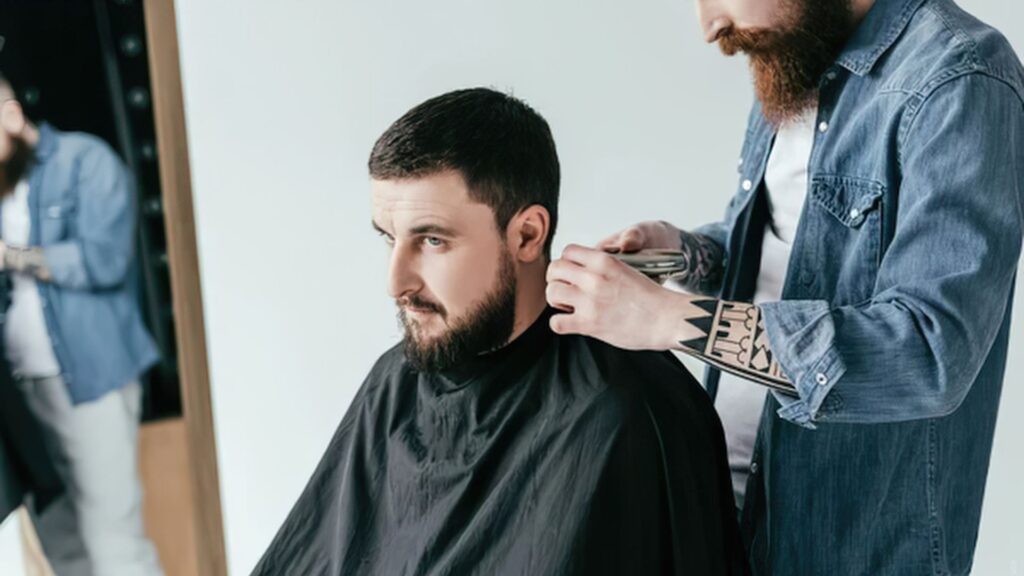
A shelf is a visible ledge where short hair suddenly meets longer hair. On day one, it can be hidden by tight blending and fresh edges. By day fourteen, it often appears as if from nowhere.
Shelves usually come from one of these causes:
- The fade or weight line was placed right on the occipital bone or parietal ridge
- The blend between guard lengths was rushed
- The top was left much longer than the sides with no transition
It’s like a staircase missing a step. You might not notice it when the lights are on and you’re walking carefully. But eventually, you’ll trip.
Lopsided Sideburns and Uneven Sides
Small differences on day one can turn into obvious ones by week two. A sideburn that’s an eighth of an inch shorter on one side will look much more uneven once both grow in.
| Warning Sign | What It Looks Like | Likely Cause |
| Lopsided sideburns | One sits higher than the other | Cut from the side rather than checked from the front |
| One side puffs out | Fuller on one side | Uneven bulk removal |
| Uneven ear outline | One ear looks more exposed | Mismatched trimming |
| Crooked part | Line drifts as it grows | Part cut against natural fall |
| Temple mismatch | One temple recedes more | Hairline not accounted for |
Most heads aren’t perfectly symmetrical, so a little difference is natural. But if one side looks clearly different from the other at two weeks, it seems likely something was off during the cut itself.
Cowlicks That Wake Up and Bulk That Balloons
Cowlicks and whorls can stay quiet for the first few days, especially when held down by product. Then, around the second week, they wake up.
If your crown suddenly splits, flips, or sticks straight up, the cut may have been too short in that spot. A cowlick usually needs enough length to weigh it down. Cut it too short, and it stands up like a startled cat.
Bulk is another late-arriving problem. Thick hair that wasn’t thinned or texturized properly can look fine on day one and then balloon outward by day ten. The sides puff, the top widens, and your head starts looking like a mushroom.
Neither of these is a disaster. Both can usually be fixed at your next visit. But noticing them helps you have a clearer conversation with your barber.
And how much you notice depends a lot on which style you’re wearing.
Every Style Ages Differently
Skin Fade vs. Classic Taper
Here’s one of the most common comparisons I talk through with clients.
| Factor | Skin Fade | Classic Taper |
| Shortest length | Bare skin | About 1/8 to 1/4 inch |
| Look on day one | Dramatic, sharp contrast | Clean, subtle |
| Look on day fourteen | Noticeably grown in | Still tidy |
| Grow-out visibility | High | Low |
| Typical return visit | Every 2 to 3 weeks | Every 3 to 5 weeks |
| Best for | Men who love a fresh look and visit often | Men who want low maintenance |
A skin fade starts from bare skin, so any growth is obvious. At two weeks, it may already look like a different cut. A taper starts with some length, so the change is gentler.
Neither is better. A skin fade is like a freshly washed black truck. It looks stunning, but you’ll see every speck of dust. A taper is more like a gray pickup. It hides the dirt longer.
Buzz Cut vs. Crew Cut
| Factor | Buzz Cut | Crew Cut |
| Length | Same short length all over | Short sides, slightly longer top |
| Structure | Almost none | Light graduation |
| Day-fourteen look | Uniformly fuller | Top grows faster visually |
| Risk at two weeks | Uneven growth patches show | Top may start to lose shape |
| Home maintenance | Easy with clippers | Harder to keep the shape |
| Typical return visit | Every 2 to 4 weeks | Every 3 to 4 weeks |
The buzz cut is perhaps the simplest grow-out of all. Everything grows at once, so the cut just gets slightly longer. But if you have patchy growth or a cowlick, a buzz cut can expose it by week two.
A crew cut has more structure, which means it holds its shape a bit better, but it also means the top can drift out of proportion if you wait too long.
Textured Crop vs. Longer Scissor Cut
The textured crop, with its short fringe and choppy top, has become one of the most requested styles of the last decade. It usually pairs a mid or high fade with a heavily textured top.
| Factor | Textured Crop | Longer Scissor Cut |
| Top length | 1 to 2.5 inches | 3 inches or more |
| Sides | Faded | Scissor-cut or long taper |
| Grow-out at two weeks | Fade softens, fringe lengthens | Barely noticeable |
| Main risk | Fringe falls into eyes | Bulk builds at sides |
| Typical return visit | Every 3 to 4 weeks | Every 5 to 8 weeks |
With a crop, the fringe is often the first thing to bother you. A quarter inch doesn’t sound like much until it’s poking your eyelashes.
With a longer scissor cut, two weeks of growth is mostly invisible. Here, the two-week check is less about edges and more about whether the shape sits naturally after a dozen washes.
Sharp Edges and the Line-Up Problem
Edges are the frame of the haircut. They’re also the first thing to go.
A line up haircut, with a crisp, straight-razor outline at the forehead, temples, and beard, looks razor-sharp on day one. By day three, a shadow appears. By day seven, the line has softened. By day fourteen, it has usually blurred into natural growth.
That’s not a flaw. It’s just the nature of a sharp edge. I often explain it like a fresh coat of white paint on a fence. It’s never brighter than the day it dries.
There’s one caution worth mentioning. If a line-up is pushed back too far beyond your natural hairline, the grow-out can look uneven, since hair returns in its original shape rather than the cut shape. Many barbers, myself included, prefer to respect the natural hairline so the grow-out looks gentler.
Style is only part of the story, though. Your hair type quietly sets the pace too.
How Hair Type Changes the Clock
Straight and Wavy Hair
Straight hair is honest. It shows every line, every step, every small mistake. That makes it easy to judge at two weeks, sometimes easier than you’d like.
Straight hair also tends to stick out as it grows, especially around the ears and the back of the neck. Thick, coarse straight hair can start to fan outward by day ten, giving the sides a wider look.
Wavy hair is a little more forgiving. The natural bend hides small blending flaws. But waves can shift as the hair gets longer, so a cut that sat neatly at day one may start forming unexpected flips or swirls by day fourteen.
Curly and Coily Hair
Curly and coily hair often hides grow-out beautifully, because curls cluster together and blur any small unevenness.
But there’s a twist. Curls also shrink. A curl that would measure an inch stretched out might only sit at a third of that when dry. That means growth shows differently, and the overall shape can change even when individual hairs have barely lengthened.
| Hair Type | How Grow-Out Shows | Common Two-Week Issue | What to Watch |
| Straight | Clearly, line by line | Sides stick out | Ear outline, neckline |
| Wavy | Moderately | New flips appear | Crown and temples |
| Curly | Softly, in clumps | Shape widens | Overall silhouette |
| Coily | Gently, but outline blurs | Edges lose definition | Hairline, shape uniformity |
Remember the Loussouarn research from the British Journal of Dermatology: coily hair tends to grow more slowly in length. So a coily-haired client might go a few days longer before his shape needs attention, even though his edges may soften just as quickly as anyone’s.
With coily hair, I often think like a sculptor. The goal is a clean, even silhouette, and the two-week check is mostly about whether that outline has stayed round and balanced.
Fine Hair vs. Thick Hair
| Factor | Fine Hair | Thick Hair |
| How grow-out shows | Lies flat, may look thin | Puffs, adds bulk |
| Two-week risk | Top loses volume | Sides balloon outward |
| What the barber should do | Leave weight for fullness | Remove bulk and texturize |
| Product help | Lightweight volumizers | Matte clays, stronger holds |
| Typical return visit | Every 4 to 5 weeks | Every 3 to 4 weeks |
Fine hair often grows out flat and limp, especially on top. By day fourteen, it may start separating and showing more scalp.
Thick hair goes the opposite direction. It builds bulk fast, and by day fourteen, the sides might look fuller than you’d like. Proper thinning during the cut makes a huge difference here.
It seems the same two weeks can feel very different depending on what’s growing out of your scalp. And what you do with that hair matters too.
Your Habits Shape the Grow-Out
Washing, Products and Heat
How you treat your hair between visits shapes how it ages.
| Habit | Helps Grow-Out | Hurts Grow-Out |
| Washing | Gentle shampoo 2 to 4 times a week | Daily harsh shampoo that strips oil |
| Conditioning | Regular light conditioner | Skipping it on curly or coarse hair |
| Products | Matched to your hair type | Heavy wax on fine hair |
| Heat | Low-heat blow-drying | Daily high heat |
| Towel drying | Gentle pat | Rough rubbing |
Heavy products can mask how your cut is really growing. If you rely on strong pomade every day, try one product-free morning around day twelve. Look at your hair as it naturally falls. That’s the cut you’re really wearing.
Hats, Helmets and Pillows
Hats press hair flat at the sides and push it outward along the brim. Helmets do the same, only more so. Over two weeks, these habits train your hair to sit in certain ways.
I’ve had construction workers, cyclists, and high school football players come in with the same complaint: “My sides stick out.” Nine times out of ten, it’s the hat or helmet. The fix is usually a shorter side or a slightly different weight placement.
Pillows matter too. If you sleep on one side every night, your hair on that side may grow out flatter. I once had a client whose left side always looked fuller. It took us three visits to figure out he slept on his right side every single night.
Sweat, Sun and Stress
Sweat can loosen product and make hair clump, especially if you work out daily. Sun exposure can dry out the hair shaft, making ends rougher and more prone to sticking out.
Seasons may play a role too. A study by Valerie Randall and F. John Ebling, published in the British Journal of Dermatology, followed men over 18 months and found seasonal shifts in the hair growth cycle, with shedding tending to rise in late summer and autumn. Some men notice their cuts seem to “thin” or lose fullness more quickly at that time of year.
Stress affects hair as well. The American Academy of Dermatology notes that a major stressful event can trigger noticeable shedding, called telogen effluvium, usually two to three months later. If your cut suddenly looks thinner at two weeks and you’ve been through a tough season, perhaps it’s worth being patient with yourself and your barber.
Habits matter, but so does how you judge what you see. That’s where many of us slip up.
Common Mistakes Men Make When Judging a Cut
Judging Too Soon vs. Judging Too Late
| Factor | Judging Too Soon (Days 1 to 3) | Judging Too Late (Week 4 and Beyond) |
| What you see | Fresh edges, product, blow-dry | Overgrown hair, lost shape |
| Accuracy | Low, too much is hidden | Low, too much has changed |
| Common reaction | “This is perfect” or “I hate it” | “This barber didn’t get it” |
| Better approach | Wait until after two washes | Check at two weeks instead |
Judging too soon is like rating a steak while it’s still sizzling on the grill. Judging too late is like rating it after it’s sat in the fridge overnight. Neither gives you the real flavor.
Blaming the Barber for Biology
Sometimes a cut grows out unevenly, and it isn’t anyone’s fault. Your hair has growth patterns, cowlicks, and areas that grow faster or slower. Some hair loss, especially at the crown or temples, can change how a cut ages.
The American Hair Loss Association reports that roughly two-thirds of American men experience some noticeable hair loss by age 35. That’s a big share of the men in my chair. When the crown begins to thin, the grow-out naturally looks different, and no cut can fully stop that.
I noticed that men are often quicker to blame the barber than to consider biology. That’s understandable. It’s easier to change barbers than to accept a receding hairline. But a good barber will help you see what’s happening and adjust.
Loyal Barber vs. Barber Hopping
| Factor | Staying With One Barber | Barber Hopping |
| Knowledge of your head | Builds over time | Starts from zero each visit |
| Consistency | High | Unpredictable |
| Adjustments | Fine-tuned each visit | Rarely build on each other |
| Grow-out quality | Improves over time | Varies widely |
| Relationship | Trust and conversation | Transactional |
Every head has quirks. A barber who has cut your hair five or six times knows where your crown swirls, where the bump at the back sits, and how your sides grow in. That knowledge pays off at the two-week mark.
It’s like a quarterback and a receiver who’ve practiced together for years. They know each other’s timing without saying a word.
Forgetting to Speak Up
Perhaps the biggest mistake of all is noticing a problem at two weeks and saying nothing.
Barbers want to hear it. Truly. If your crown flipped up at day ten, or your sides puffed out at day twelve, tell your barber at your next visit. That information is gold. It’s the feedback we can’t get any other way, since we only see your hair on day zero.
Saying it doesn’t need to be confrontational. Something as simple as “Around two weeks in, my sides started sticking out” gives your barber something real to work with.
Sometimes the best lessons come from real people, so let me share a few.
Stories From the Chair
The Groom Who Booked Too Early
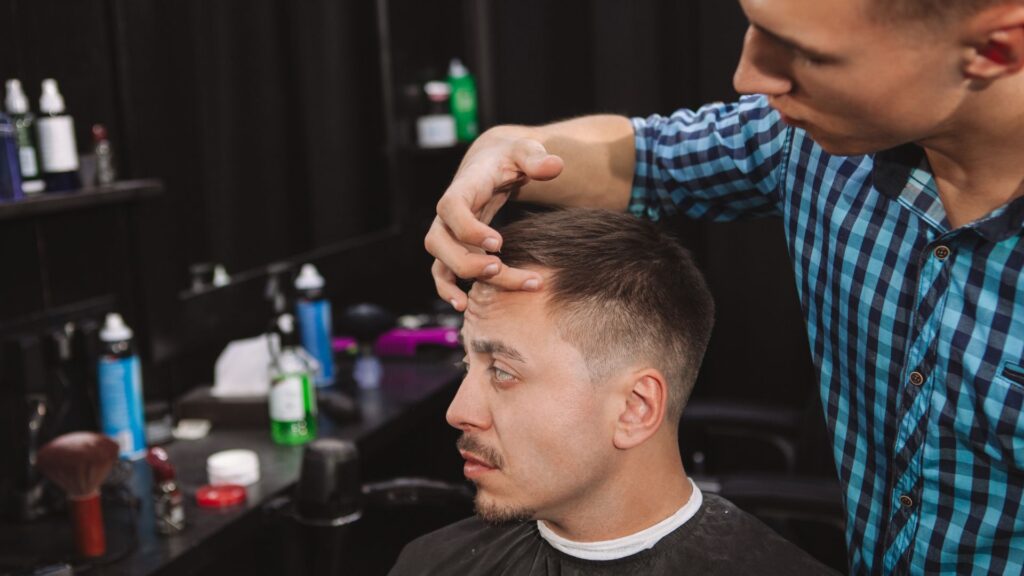
A young man named Tyler booked a skin fade three weeks before his wedding. He wanted to “make sure it looked good” and planned to come back the week of the wedding.
Then life happened. Caterers, seating charts, a lost suit. He never came back.
By the wedding day, his skin fade had grown into a soft, slightly fuzzy taper. The photos still looked fine. But he told me later that every time he sees them, he notices the neckline.
Since then, I’ve suggested a simple plan for big events: get your main cut about a week before, then a quick cleanup two or three days out. Perhaps it seems like overkill. But a wedding album lasts a lot longer than two weeks.
The Father and Son on One Calendar
A father brought his twelve-year-old son in every month on the same day. Same time, same chairs, side by side. It was clearly a ritual they both loved. The boy always sat up a little straighter when his dad was next to him.
But I noticed something. The father wore a classic taper, which held up well for four weeks. The son wore a high skin fade, which looked fuzzy after two.
So we tried something. The son came in for a quick cleanup at the two-week mark, sometimes on his own, sometimes with his mom. The full father-son visit stayed monthly. The boy’s cut stayed sharp, and the Saturday ritual stayed sacred.
It reminded me that the two-week rule isn’t just about hair. It’s about matching a cut to the life it lives in.
The Gift Card That Started a Habit
A woman once came in to buy a gift card for her husband. She told me, half laughing, that he’d been cutting his own hair since college and it showed.
He came in a few weeks later, a little reluctant. We gave him a simple, well-blended taper. At his two-week mark, he sent his wife a photo from work with the message, “Still looks good.” She showed me on her phone when she came back to buy another gift card.
He’s been a regular ever since. Sometimes I think the best gift isn’t the haircut itself. It’s discovering what it feels like to have a cut that still looks good two weeks later.
Stories like these often lead to practical questions about money and timing.
Cost, Value and Timing Your Visits
What a Haircut Really Costs Per Week
Most men think about a haircut’s price per visit. It may be more useful to think about price per week of good-looking hair. IBISWorld tracks the U.S. barber shop industry as a multibillion-dollar market, and much of that spending comes from men returning on a steady rhythm. The rhythm itself shapes what you actually pay.
| Cut Type | Example Price | Weeks It Looks Good | Approximate Cost Per Week |
| Budget clipper cut | $20 | 1.5 to 2 | $10 to $13 |
| Standard taper | $35 | 3 to 4 | $9 to $12 |
| Precision skin fade | $45 | 2 to 3 | $15 to $23 |
| Scissor cut with texture | $55 | 4 to 6 | $9 to $14 |
| Cut with beard sculpting | $65 | 3 to 4 | $16 to $22 |
Prices vary by city and barber, so treat these as rough examples. But look at what happens. A $20 cut that falls apart at ten days may cost about the same per week as a $35 cut that holds for four weeks. And it spends more of its life looking rough.
Two-Week Schedule vs. Four-Week Schedule
| Factor | Every Two Weeks | Every Four Weeks |
| Visits per year | About 26 | About 13 |
| Annual cost at $40 per cut | About $1,040 | About $520 |
| Look between visits | Consistently sharp | Sharp, then softer |
| Best for | Skin fades, line-ups, image-focused jobs | Tapers, scissor cuts, relaxed styles |
| Relationship with barber | Very close | Steady |
Neither schedule is right for everyone. A two-week rhythm suits men who want to look freshly cut at all times. A four-week rhythm suits men who are comfortable with a softer look in the second half of the cycle.
Perhaps the better question is this: how do you want to feel on day twenty?
Neck Trim vs. Full Cut
Many shops offer quick neck trims or cleanups between full cuts. These usually take ten to fifteen minutes and cost much less.
| Factor | Neck Trim or Cleanup | Full Cut |
| Time | 10 to 15 minutes | 30 to 60 minutes |
| Typical cost | $10 to $20 | $30 to $70 |
| What’s done | Neckline, around ears, edges | Full reshape, blend, top |
| Best timing | Around day 14 | Every 3 to 6 weeks |
| Effect | Restores sharpness | Restores shape |
A cleanup at the two-week mark can stretch a full cut from three weeks to five. It’s like getting your car washed between oil changes. The engine’s fine. It just needs to shine again.
When to Spend More and When to Save
Professional haircuts aren’t always about spending more. They’re about spending well.
It may make sense to spend more when:
- You’re new to a barber and want time for a full consultation
- You have a tricky head shape, cowlicks, or thinning
- You wear a high-maintenance style like a skin fade
- You have a big event coming up
It may make sense to save when:
- Your cut is well established and just needs a cleanup
- You wear a low-maintenance taper or longer scissor cut
- You’re comfortable with a softer grow-out
The U.S. Bureau of Labor Statistics projects continued growth in demand for barbers, hairstylists, and cosmetologists through the early 2030s. More men seem to be treating grooming as part of their routine rather than an occasional chore, and budgeting for it the way they’d budget for a gym membership.
Speaking of changing habits, let’s look at what barbers are noticing right now.
What Barbers Are Seeing Now
Softer Fades and Longer Wear
Over the past few years, I’ve noticed a gentle shift. Many men are moving from tight skin fades to softer tapers, burst fades, and low fades that start with a little length.
Part of this is style. Textured crops, modern mullets, and natural curls all lean toward a relaxed look. But part of it, I suspect, is practical. Men want cuts that still look good at two weeks without needing another visit.
When I talk with other barbers at trade shows and in the shop, the same theme comes up. Clients are asking, “How will this look in three weeks?” more than they used to. That’s a good question. It shows they’re thinking about the whole life of the cut, not just the first day.
Booking Habits Are Changing
| Trend | What’s Happening | Effect on Grow-Out |
| Online booking | Easy to schedule the next visit | More consistent timing |
| Memberships and subscriptions | Flat monthly fee for set visits | Encourages two-week cleanups |
| Pre-booking at checkout | Next visit set before leaving | Fewer overgrown cuts |
| Text reminders | Automatic nudges | Fewer missed appointments |
| Cleanup-only services | Quick, affordable edge-ups | Stretches full cuts longer |
Some shops now offer monthly memberships that include a full cut and one or two cleanups. For men who love a sharp fade, that can be a smart way to stay fresh while keeping costs predictable.
The Grow-Out Conversation Belongs in the Consultation
Perhaps the most valuable shift is a simple conversation. More barbers, myself included, now ask about grow-out during the consultation.
I might ask:
- “How often can you realistically come in?”
- “Do you want this to look sharp for two weeks or decent for five?”
- “Is there an event coming up?”
- “Where does your hair usually start bothering you first?”
These questions change how I build the cut. A man who visits every two weeks can handle a tight skin fade. A man who comes in every six weeks needs more length and softer transitions.
It seems obvious when you say it out loud. Yet for many years, nobody asked. Now, more of us do.
Let’s turn to the questions I hear most often in the chair.
Frequently Asked Questions
Why two weeks and not one or three?
One week is usually too early. Your hair hasn’t grown enough to reveal the cut’s real structure, and the fresh edges still hide a lot. Three weeks is often too late, especially for fades, because so much has changed that it’s hard to separate the original cut from normal growth. At two weeks, hair has grown about a quarter inch, enough to expose the shape, but the cut should still look intentional. It’s a fair midpoint for most styles.
Does the two-week rule apply to every haircut?
It applies most clearly to short and medium cuts, especially fades, tapers, and crops. For longer scissor cuts, two weeks of growth is barely visible, so you might stretch your check to three or four weeks. For buzz cuts, the two-week mark mostly tells you whether your growth is even across your scalp. The idea stays the same: judge the cut after it has lived a little.
What if my cut looks bad at day three?
Give it a few more days if you can. Many cuts look odd before they’ve been washed and styled a couple of times, especially after a big change in length. That said, if something seems clearly uneven, like a sideburn that’s obviously shorter or a visible hole, it’s fair to call your barber early. Most barbers would rather fix a small issue right away than have you walk around unhappy.
Is it rude to ask my barber to fix something after two weeks?
Not at all. Most good barbers welcome feedback, and many will touch up an obvious issue within the first week or so at no charge. After two weeks, it’s usually better to mention it at your next appointment. Be specific about what you noticed and when. Your barber can’t see your hair between visits, so your observations help him build a better cut next time.
How can I make my cut last longer?
Choose a style that matches how often you can visit. Ask for a slightly lower fade or a taper instead of a skin fade. Use products that suit your hair type, and avoid heavy wax on fine hair. Consider a quick neckline cleanup around day fourteen. And tell your barber how long you’d like the cut to last, so he can leave a little extra length where it’ll help.
Should I trim my own neckline between visits?
You can, but carefully. A light cleanup of stray hairs below your natural neckline is usually fine. Avoid trying to raise or reshape the neckline yourself. Many men accidentally push it higher each time, and by the next visit, the barber has to work around a line that’s crept up the back of the head. If you’re unsure, a quick professional cleanup is often worth the small cost.
Why does my fade look darker on one side after two weeks?
There are a few possible reasons. Your hair may grow slightly faster on one side. You might sleep on one side more, which can flatten or push hair differently. Or the blend may have been slightly uneven to begin with. Lighting also plays tricks, so check both sides in the same even light before deciding. If the difference is clear and consistent, mention it at your next visit.
When should my son get his hair checked?
Boys’ cuts often grow out faster visually, especially fades, because kids tend to choose shorter, sharper styles. Many parents find that a quick cleanup around two weeks keeps a fade looking neat without needing a full cut. For softer styles, like a classic taper or a longer crop, four weeks is often fine. Watching how his hair looks at the two-week mark can help you decide which rhythm suits him and your family’s schedule.
A Final Word From the Chair
I still think about Marcus and his line about cutting his hair in a truck mirror. He wasn’t asking for perfection. He was asking for a haircut that kept its promise a little longer. That’s really what the two-week rule is about. Not perfection, not judgment, but noticing. Noticing how your hair grows. Noticing where your head curves and where it flattens. Noticing which habits help your cut and which ones quietly work against it. The next time you’re in the chair, with the buzz of clippers near your ear, the cool snip of steel scissors above your brow, and the warmth of the leather beneath you, perhaps you’ll find yourself thinking not just about how the cut looks right now, but about how it might look on that fourteenth morning. What would you want to see in the mirror then? If this way of looking at your haircut feels useful, take it with you. If it doesn’t quite fit how you see things, that’s fine too. Every head grows in its own way, and after all these years behind the chair, I’m still learning to read each one, two weeks at a time.
The Two-Week Rule: How to Judge Whether Your Haircut Is Growing Well
Meta Title: The Two-Week Rule: How to Judge Your Haircut’s Grow-Out – Elegant G Barbershop
Meta Description: A master barber explains the two-week rule: what should soften, what should hold, and how to tell if your haircut is growing out well or was off from the start.
Fourteen Days Tells the Truth
The Man Who Came Back Smiling
Marcus first sat in my chair on a rainy Thursday. He was a contractor with sawdust still on his boots. Right away he told me he’d had three different barbers in three months, and none of them had “gotten it right.”
I asked him what “right” looked like.
He thought about it for a moment while I snapped the cape around his neck. “It looks great when I leave,” he said. “Then about ten days later, it looks like I cut it myself in a truck mirror.”
That sentence stuck with me. He wasn’t unhappy with the haircut. He was unhappy with how it aged.
So we built his cut a little differently. I kept the fade a touch lower, left more weight over a flat spot at the back of his head, and softened his neckline into a taper instead of a hard block. When he left, it looked good. Not dramatic. Just good.
Two weeks later he walked back in, and he wasn’t there for a cut. He’d stopped by to pay for his buddy’s appointment. He pointed at his own head and grinned. “Still looks like a haircut,” he said. “That’s new.”
I’ve thought about Marcus many times since. Perhaps he taught me more than I taught him. He reminded me that a cut doesn’t live in the chair. It lives in your bathroom mirror, your work meetings, your kid’s soccer games, and your Tuesday mornings when you’re running late.
Why Day One Can Fool You
There’s something a little magical about the moment you stand up from the chair. The hot towel has just come off your neck. The talc is still dusted across your collar. The edges are crisp, the product is fresh, and your barber spins you around with the hand mirror so you can admire the back.
Almost every cut looks good at that moment.
I noticed long ago that day one is a bit like a brand-new car on the dealer’s lot. It’s washed, waxed, and parked under perfect lights. You don’t really know what you’ve bought until you’ve driven it through a few rainstorms.
A haircut on day one hides several things:
- Fresh edges cover uneven growth patterns underneath
- Styling product holds hair in place that might not sit there naturally
- Skin-short areas haven’t started to show their real shape
- Blow-drying lifts and positions hair in ways you might not repeat at home
None of this is dishonest. It’s simply that a freshly finished cut is at its peak. The question worth asking is how it behaves on the way down.
What the Two-Week Rule Actually Is
The two-week rule is a simple idea: judge your haircut at the fourteen-day mark, not the day you get it.
By two weeks, the cut has had time to grow, settle, get washed a dozen times, and live through your actual routine. Short areas have grown enough to reveal their true shape. Any hidden mistakes, like a weight line in the wrong place or uneven blending, have had time to surface.
It seems to me that two weeks is the sweet spot for three reasons:
- It’s long enough for hair to grow roughly a quarter inch, which exposes the structure underneath
- It’s short enough that a well-built cut should still look intentional
- It’s practical, because it falls about halfway through the typical three-to-four-week cycle most men follow
Think of it like a coach reviewing game film. The final score tells you something, but watching the second quarter tells you far more about how the team actually plays.
To understand why two weeks reveals so much, it helps to look at what’s happening under the skin.
What Happens Under the Cut: The Science of Growth
Half an Inch a Month, Give or Take
According to the American Academy of Dermatology, scalp hair grows about six inches per year. That works out to roughly half an inch a month, or a little over a third of a millimeter every day.
Those numbers sound tiny. On a long scissor cut, they barely register. But on a skin fade, they change everything.
| Days After the Cut | Approximate Growth | What a Skin Fade Starts to Resemble |
| Day 3 | About 1.3 mm (1/16 inch) | A light shadow |
| Day 7 | About 3 mm (1/8 inch) | A #1 guard |
| Day 14 | About 6 mm (1/4 inch) | A #2 guard |
| Day 21 | About 9 mm (3/8 inch) | A #3 guard |
| Day 28 | About 12 to 13 mm (1/2 inch) | A #4 guard |
Look at day fourteen. The skin-short area at the bottom of your fade now holds as much hair as a #2 guard leaves behind. That’s not a small shift. It’s a whole new haircut growing in underneath the old one.
This is why I always tell clients that a fade isn’t one cut. It’s a moving gradient that changes shape every single day.
Anagen, Catagen and Telogen
Every hair on your head cycles through three main phases. Dermatologists, including those at the Cleveland Clinic, describe them like this:
| Phase | What Happens | Typical Length | Share of Scalp Hair |
| Anagen | Active growth | 2 to 7 years | About 85 to 90 percent |
| Catagen | Growth slows, follicle shrinks | About 2 to 3 weeks | Around 1 percent |
| Telogen | Resting, then shedding | About 3 months | Roughly 10 to 15 percent |
The American Academy of Dermatology notes that most people shed between 50 and 100 hairs a day. That’s normal. It’s the telogen hairs finishing their run.
Why does this matter for your cut? Because not every hair in a given patch is growing at the same moment. Some are sprinting. Some are resting. Over two weeks, that mix creates tiny differences in length that can make a section look a little less even than it did on day one.
Why Every Hair Keeps Its Own Clock
Growth speed isn’t the same for everyone, or even across one head. A study by Geneviève Loussouarn and colleagues, published in the British Journal of Dermatology, measured growth rates across different hair types and found that tightly coiled African hair grew at roughly 0.26 mm per day, while Caucasian and Asian hair grew noticeably faster, closer to 0.4 mm per day.
I’ve seen this play out behind the chair for decades. Two men can leave with the same skin fade on the same afternoon, and at day fourteen, one looks freshly faded while the other looks like he’s ready for a cleanup.
Growth can also vary by area. Many men notice their sides and nape seem to fill in faster than the top. Part of that is perception, since short hair shows growth more clearly, and part of it is simply the individual rhythm of each follicle.
Perhaps the takeaway is this: your two-week check isn’t about comparing your head to anyone else’s. It’s about comparing your cut to itself.
Knowing how hair grows is one piece. Knowing how men have timed their cuts through the years adds another.
Where the Rule Came From
The Saturday Trim and the Weekly Shave
When I was a young apprentice, the old-timers in the shop where I trained told stories about men who came in every Saturday. Some came for a shave. Some came for a quick trim around the ears. Many came just to sit, read the paper, and argue about baseball.
In the early and mid-1900s, the neighborhood barbershop was a weekly ritual for a lot of American men. Hair was cut short and neat, and keeping it that way meant frequent visits. The two-week mark wasn’t really a “rule” back then. It was just part of the rhythm of life, like mowing the lawn or polishing your shoes for church.
I still remember the smell of those old shops: bay rum, hot lather, leather strops hanging from the chair, and that faint powdery sweetness of talc in the air. Men didn’t judge their cuts at fourteen days because they rarely let them get that far.
The Fade Changed the Clock
Then the fade arrived, and the clock changed.
| Era | Popular Style | Typical Visit Rhythm | How Grow-Out Was Judged |
| 1920s to 1940s | Short back and sides | Weekly to biweekly | Neatness around ears and collar |
| 1950s | Flattop, crew cut | Every 1 to 2 weeks | Flatness and squareness of the top |
| 1960s to 1970s | Longer, shaggier styles | Every 6 to 8 weeks | Overall shape, not edges |
| 1980s to 1990s | Hi-top fade, early skin fades | Every 1 to 3 weeks | Sharpness of the fade and outline |
| 2000s | Low-maintenance crops | Every 3 to 5 weeks | Overall tidiness |
| 2010s | Skin fades, undercuts | Every 2 to 3 weeks | Smoothness of the gradient |
| 2020s | Softer fades, textured crops, mullets | Every 3 to 5 weeks | How gracefully the shape grows |
When the long, loose styles of the late 1960s and 1970s took over, many men stretched their visits to six weeks or more. Then the fade came roaring back through the 1980s and 1990s, especially in Black barbering culture, where precision blending became an art form. Suddenly, a few days of growth mattered again.
It seems the two-week rule grew out of fade culture. When your cut depends on millimeters, you start paying close attention to how fast those millimeters disappear.
From Appointment Cards to Booking Apps
For decades, barbers handed out little paper appointment cards with the next date scribbled in pen. Many men tucked them into their wallets and forgot about them until they found them months later, soft and faded, next to an old lottery ticket.
Online booking changed that. Now you can schedule your next visit before you’ve even brushed the hair off your neck. Many shops send reminders automatically.
I noticed that this convenience has a quiet side effect. Men are thinking more about timing than they used to. They’re asking, “When should I come back?” instead of “When does it look bad enough?” And the two-week mark has become a natural moment to pause and ask whether the cut is aging well.
So what exactly should you be looking for when that moment arrives?
Day One vs. Day Fourteen: What Should Change and What Shouldn’t
What Is Supposed to Soften
Some changes are perfectly normal. In fact, if these didn’t happen, I’d be a little worried.
By day fourteen, you can expect:
- The fade to darken. The skin-short areas will have grown in, so the gradient looks shorter and less dramatic.
- The edges to blur. A crisp neckline and sharp temples will have softened with new growth.
- The ears to look a little fuller around the edges. Hair grows around them and starts touching the tops.
- The top to lose a little of its lift. As it grows heavier, it may lie down more easily.
These changes are like the tan lines fading after summer vacation. They’re expected. They don’t mean anything went wrong.
What Should Hold Firm
Other things shouldn’t change much, even at two weeks. These are the bones of the haircut, the structure your barber built.
- The overall silhouette. From a few feet away, the shape of your head should look about the same as day one.
- Balance between sides. If your left and right sides matched on day one, they should still match.
- The weight line placement. Where the short sides meet the longer top should still sit in a flattering spot.
- How the top behaves. If you could style it easily on day three, you should still be able to style it on day fourteen.
A well-built cut is like a well-built house. The paint might fade and the lawn might grow, but the walls stay straight.
Growing Out vs. Falling Apart
This is perhaps the most important comparison in the whole blog. There’s a big difference between a cut that’s growing out naturally and one that’s falling apart.
| Factor | Growing Out Well | Falling Apart |
| Silhouette | Same shape, just fuller | Shape has changed or bulged |
| Sides | Evenly filled in | One side noticeably fuller |
| Back | Still rounded | Shelf, dent or hump appears |
| Top | Styles as before | Won’t sit, sticks out, flops |
| Neckline | Soft and natural | Crooked or patchy |
| Weight line | Blended, gently visible | Harsh, obvious step |
| Your feeling | “Needs a cleanup soon” | “Something is wrong” |
That last row matters more than you might think. I’ve noticed that men often sense the difference before they can explain it. A cut growing out well feels like an old friend who needs a shave. A cut falling apart feels like a stranger wearing your clothes.
Now let’s walk through what those fourteen days usually look like, one stretch at a time.
A Day-by-Day Map of the First Two Weeks
Days 1 to 3: The Settling Period
The first few days are about settling. Your hair has just been cut, possibly blow-dried, and styled with product. It needs a few washes to find its natural fall.
During these days, you might notice:
- The top feels a little stiff or “new”
- Some sections stick up where they were cut shortest
- Your skin feels tender if you had a skin fade or straight-razor outline
- The style looks slightly different when you do it yourself
This is a bit like breaking in a new pair of leather boots. They feel stiff at first, and then they start to shape around you. I usually tell clients not to judge anything until they’ve washed and styled it themselves at least twice.
Days 4 to 7: The Honest Week
Somewhere around day four, the cut starts telling the truth. The product has washed out. The blow-dry lift is gone. Your hair is doing what it naturally wants to do.
This is when you’ll first spot your growth patterns. A cowlick at the crown might start lifting. Hair around the ears might start to curl outward. The sharp edges of your outline will have a soft shadow.
It seems to me that this stretch reveals how well the cut matches your natural hair, while the next stretch reveals how well it matches your head shape.
Days 8 to 11: The Shape Shows Its Bones
By the second week, enough growth has arrived to show the real structure. On a fade, the blend is now darker and the transitions are clearer. On a scissor cut, the weight has started to shift.
| Days | What You’ll Notice | What It Tells You |
| 1 to 3 | Stiffness, fresh edges, product hold | Very little about the cut’s quality |
| 4 to 7 | Natural fall, growth patterns appear | How well the cut matches your hair |
| 8 to 11 | Blend darkens, weight shifts | How well the cut matches your head shape |
| 12 to 14 | Full structure visible | Whether the cut was built to last |
This is where a poorly placed weight line starts to look like a ridge. It’s also where a well-placed one quietly does its job without drawing attention.
Days 12 to 14: Judgment Day
By the end of the second week, you’ve lived with the cut. You’ve slept on it, sweated in it, worn a hat over it, and washed it more than a dozen times.
This is the moment to ask yourself a simple question: does this still look like a haircut, or does it look like hair?
That’s not a trick question. A cut that’s aging well still has visible intention. You can see the shape your barber built. A cut that’s falling apart has lost that intention, and it simply looks like hair growing wherever it wants.
So how do you actually check, especially the parts you can’t see?
How to Run Your Own Two-Week Check
Set Up Your Mirrors and Your Light
Most men judge their haircut in a bathroom mirror under a single overhead bulb. That’s a bit like judging a used car in a dark parking garage.
Here’s a simple setup that works:
- Stand in natural daylight near a window, or under bright, even light
- Use two mirrors, your main mirror and a handheld one, to see the back
- Avoid harsh overhead light that casts shadows and hides blending
- Dry your hair fully before checking, since wet hair hides shape
I once had a client who was convinced his fade was uneven. He’d been checking it under a single bulb that hung on one side of his bathroom. When we looked at it in the shop’s front window light, it was perfectly fine. The shadow had been lying to him the whole time.
The Six-Angle Photo Method
The easiest way to judge your cut is to take photos on day one and again on day fourteen. Use the same lighting, the same angles, and dry, unstyled hair if possible.
| Angle | How to Take It | What to Check |
| Front | Face the camera straight on | Sideburns, temples, side balance |
| Left side | Turn your head fully left | Fade blend, ear outline |
| Right side | Turn your head fully right | Compare to the left side |
| Back | Ask someone or use a timer | Neckline, shelf, roundness |
| Crown | Hold the phone above and behind | Cowlicks, gaps, lift |
| Three-quarter | Turn halfway | Flow from front to side |
Put the two sets of photos side by side. You’re not looking for a perfect match. Hair grows, after all. You’re looking for whether the shape stayed recognizable.
The Hand Test and the Day-One Comparison
Your hands can feel what your eyes might miss. Run your palm slowly from the nape of your neck upward toward the crown. Then do the same on each side, from above the ear toward the top.
On a well-built cut, your hand should glide smoothly. You’ll feel the length increase gradually. On a cut with problems, you’ll feel a sudden bump, step, or ridge where the length jumps.
I often ask clients to do this right there in the chair before they leave, and again at home two weeks later. It’s like a carpenter running his hand along a board to check for splinters. Your fingers know.
Then compare your notes and photos. Ask yourself:
- Did the outline grow evenly on both sides?
- Can I still see where my barber placed the weight?
- Does the top behave the same way it did on day three?
- Is anything bothering me that I didn’t notice before?
There’s no wrong answer here. You’re simply gathering clues.
Once you know how to check, it helps to know what good news actually looks like.
Signs Your Cut Is Growing Well
Even Fill-In Around the Ears and Neck
One of the clearest signs of a well-built cut is even fill-in. Around the ears, hair should grow in at a similar pace on both sides, so the outline softens rather than shifting.
At the neckline, a good taper simply gets a little fuzzier. It doesn’t creep down your neck in an uneven pattern or form a crooked edge. If your barber read your natural hairline well, the growth will follow the line he cut rather than fighting it.
It’s a bit like a garden bed. If the edging was cut along the natural curve of the soil, the grass grows back neatly along it. If the edging fought the curve, the grass creeps in sideways.
A Back That Stays Round
The back of your head is where many grow-out problems first show up, partly because you can’t see it without effort.
A healthy grow-out at the back keeps a rounded silhouette. The occipital bone, that bump at the back of your skull, should still be gently supported by the cut. There should be no flat spot, no dent, and no shelf.
| Sign | Healthy Grow-Out | Needs Attention |
| Roundness | Follows the curve of the skull | Flat, dented or boxy |
| Blend at the occipital bone | Smooth | Visible line or ridge |
| Crown | Lies down or lifts gently | Flips, splits or gaps |
| Neckline | Softly fuzzy | Crooked or creeping |
| Transition to sides | Seamless | Corner or bulge |
If the back still looks rounded at day fourteen, perhaps that tells you your barber understood the shape of your head.
A Top That Still Styles Easily
The final good sign is often the most practical. Can you still style your hair the same way, with the same effort?
If you used a dab of clay and a few finger passes on day three, the same routine should work on day fourteen. The top might be slightly heavier, so it may need a touch more product or a little extra lift from a blow dryer. But it shouldn’t suddenly refuse to cooperate.
I noticed that men often blame themselves when their hair gets hard to style. “I’m just bad at this,” they say. Sometimes that’s true. More often, the cut didn’t leave enough room for growth, and the top has outgrown its shape faster than expected.
Of course, not every cut ages this gracefully, and some warning signs are worth knowing.
Warning Signs Something Was Off From the Start
The Shelf That Appears Out of Nowhere
A shelf is a visible ledge where short hair suddenly meets longer hair. On day one, it can be hidden by tight blending and fresh edges. By day fourteen, it often appears as if from nowhere.
Shelves usually come from one of these causes:
- The fade or weight line was placed right on the occipital bone or parietal ridge
- The blend between guard lengths was rushed
- The top was left much longer than the sides with no transition
It’s like a staircase missing a step. You might not notice it when the lights are on and you’re walking carefully. But eventually, you’ll trip.
Lopsided Sideburns and Uneven Sides
Small differences on day one can turn into obvious ones by week two. A sideburn that’s an eighth of an inch shorter on one side will look much more uneven once both grow in.
| Warning Sign | What It Looks Like | Likely Cause |
| Lopsided sideburns | One sits higher than the other | Cut from the side rather than checked from the front |
| One side puffs out | Fuller on one side | Uneven bulk removal |
| Uneven ear outline | One ear looks more exposed | Mismatched trimming |
| Crooked part | Line drifts as it grows | Part cut against natural fall |
| Temple mismatch | One temple recedes more | Hairline not accounted for |
Most heads aren’t perfectly symmetrical, so a little difference is natural. But if one side looks clearly different from the other at two weeks, it seems likely something was off during the cut itself.
Cowlicks That Wake Up and Bulk That Balloons
Cowlicks and whorls can stay quiet for the first few days, especially when held down by product. Then, around the second week, they wake up.
If your crown suddenly splits, flips, or sticks straight up, the cut may have been too short in that spot. A cowlick usually needs enough length to weigh it down. Cut it too short, and it stands up like a startled cat.
Bulk is another late-arriving problem. Thick hair that wasn’t thinned or texturized properly can look fine on day one and then balloon outward by day ten. The sides puff, the top widens, and your head starts looking like a mushroom.
Neither of these is a disaster. Both can usually be fixed at your next visit. But noticing them helps you have a clearer conversation with your barber.
And how much you notice depends a lot on which style you’re wearing.
Every Style Ages Differently
Skin Fade vs. Classic Taper
Here’s one of the most common comparisons I talk through with clients.
| Factor | Skin Fade | Classic Taper |
| Shortest length | Bare skin | About 1/8 to 1/4 inch |
| Look on day one | Dramatic, sharp contrast | Clean, subtle |
| Look on day fourteen | Noticeably grown in | Still tidy |
| Grow-out visibility | High | Low |
| Typical return visit | Every 2 to 3 weeks | Every 3 to 5 weeks |
| Best for | Men who love a fresh look and visit often | Men who want low maintenance |
A skin fade starts from bare skin, so any growth is obvious. At two weeks, it may already look like a different cut. A taper starts with some length, so the change is gentler.
Neither is better. A skin fade is like a freshly washed black truck. It looks stunning, but you’ll see every speck of dust. A taper is more like a gray pickup. It hides the dirt longer.
Buzz Cut vs. Crew Cut
| Factor | Buzz Cut | Crew Cut |
| Length | Same short length all over | Short sides, slightly longer top |
| Structure | Almost none | Light graduation |
| Day-fourteen look | Uniformly fuller | Top grows faster visually |
| Risk at two weeks | Uneven growth patches show | Top may start to lose shape |
| Home maintenance | Easy with clippers | Harder to keep the shape |
| Typical return visit | Every 2 to 4 weeks | Every 3 to 4 weeks |
The buzz cut is perhaps the simplest grow-out of all. Everything grows at once, so the cut just gets slightly longer. But if you have patchy growth or a cowlick, a buzz cut can expose it by week two.
A crew cut has more structure, which means it holds its shape a bit better, but it also means the top can drift out of proportion if you wait too long.
Textured Crop vs. Longer Scissor Cut
The textured crop, with its short fringe and choppy top, has become one of the most requested styles of the last decade. It usually pairs a mid or high fade with a heavily textured top.
| Factor | Textured Crop | Longer Scissor Cut |
| Top length | 1 to 2.5 inches | 3 inches or more |
| Sides | Faded | Scissor-cut or long taper |
| Grow-out at two weeks | Fade softens, fringe lengthens | Barely noticeable |
| Main risk | Fringe falls into eyes | Bulk builds at sides |
| Typical return visit | Every 3 to 4 weeks | Every 5 to 8 weeks |
With a crop, the fringe is often the first thing to bother you. A quarter inch doesn’t sound like much until it’s poking your eyelashes.
With a longer scissor cut, two weeks of growth is mostly invisible. Here, the two-week check is less about edges and more about whether the shape sits naturally after a dozen washes.
Sharp Edges and the Line-Up Problem
Edges are the frame of the haircut. They’re also the first thing to go.
A line up haircut, with a crisp, straight-razor outline at the forehead, temples, and beard, looks razor-sharp on day one. By day three, a shadow appears. By day seven, the line has softened. By day fourteen, it has usually blurred into natural growth.
That’s not a flaw. It’s just the nature of a sharp edge. I often explain it like a fresh coat of white paint on a fence. It’s never brighter than the day it dries.
There’s one caution worth mentioning. If a line-up is pushed back too far beyond your natural hairline, the grow-out can look uneven, since hair returns in its original shape rather than the cut shape. Many barbers, myself included, prefer to respect the natural hairline so the grow-out looks gentler.
Style is only part of the story, though. Your hair type quietly sets the pace too.
How Hair Type Changes the Clock
Straight and Wavy Hair
Straight hair is honest. It shows every line, every step, every small mistake. That makes it easy to judge at two weeks, sometimes easier than you’d like.
Straight hair also tends to stick out as it grows, especially around the ears and the back of the neck. Thick, coarse straight hair can start to fan outward by day ten, giving the sides a wider look.
Wavy hair is a little more forgiving. The natural bend hides small blending flaws. But waves can shift as the hair gets longer, so a cut that sat neatly at day one may start forming unexpected flips or swirls by day fourteen.
Curly and Coily Hair
Curly and coily hair often hides grow-out beautifully, because curls cluster together and blur any small unevenness.
But there’s a twist. Curls also shrink. A curl that would measure an inch stretched out might only sit at a third of that when dry. That means growth shows differently, and the overall shape can change even when individual hairs have barely lengthened.
| Hair Type | How Grow-Out Shows | Common Two-Week Issue | What to Watch |
| Straight | Clearly, line by line | Sides stick out | Ear outline, neckline |
| Wavy | Moderately | New flips appear | Crown and temples |
| Curly | Softly, in clumps | Shape widens | Overall silhouette |
| Coily | Gently, but outline blurs | Edges lose definition | Hairline, shape uniformity |
Remember the Loussouarn research from the British Journal of Dermatology: coily hair tends to grow more slowly in length. So a coily-haired client might go a few days longer before his shape needs attention, even though his edges may soften just as quickly as anyone’s.
With coily hair, I often think like a sculptor. The goal is a clean, even silhouette, and the two-week check is mostly about whether that outline has stayed round and balanced.
Fine Hair vs. Thick Hair
| Factor | Fine Hair | Thick Hair |
| How grow-out shows | Lies flat, may look thin | Puffs, adds bulk |
| Two-week risk | Top loses volume | Sides balloon outward |
| What the barber should do | Leave weight for fullness | Remove bulk and texturize |
| Product help | Lightweight volumizers | Matte clays, stronger holds |
| Typical return visit | Every 4 to 5 weeks | Every 3 to 4 weeks |
Fine hair often grows out flat and limp, especially on top. By day fourteen, it may start separating and showing more scalp.
Thick hair goes the opposite direction. It builds bulk fast, and by day fourteen, the sides might look fuller than you’d like. Proper thinning during the cut makes a huge difference here.
It seems the same two weeks can feel very different depending on what’s growing out of your scalp. And what you do with that hair matters too.
Your Habits Shape the Grow-Out
Washing, Products and Heat
How you treat your hair between visits shapes how it ages.
| Habit | Helps Grow-Out | Hurts Grow-Out |
| Washing | Gentle shampoo 2 to 4 times a week | Daily harsh shampoo that strips oil |
| Conditioning | Regular light conditioner | Skipping it on curly or coarse hair |
| Products | Matched to your hair type | Heavy wax on fine hair |
| Heat | Low-heat blow-drying | Daily high heat |
| Towel drying | Gentle pat | Rough rubbing |
Heavy products can mask how your cut is really growing. If you rely on strong pomade every day, try one product-free morning around day twelve. Look at your hair as it naturally falls. That’s the cut you’re really wearing.
Hats, Helmets and Pillows
Hats press hair flat at the sides and push it outward along the brim. Helmets do the same, only more so. Over two weeks, these habits train your hair to sit in certain ways.
I’ve had construction workers, cyclists, and high school football players come in with the same complaint: “My sides stick out.” Nine times out of ten, it’s the hat or helmet. The fix is usually a shorter side or a slightly different weight placement.
Pillows matter too. If you sleep on one side every night, your hair on that side may grow out flatter. I once had a client whose left side always looked fuller. It took us three visits to figure out he slept on his right side every single night.
Sweat, Sun and Stress
Sweat can loosen product and make hair clump, especially if you work out daily. Sun exposure can dry out the hair shaft, making ends rougher and more prone to sticking out.
Seasons may play a role too. A study by Valerie Randall and F. John Ebling, published in the British Journal of Dermatology, followed men over 18 months and found seasonal shifts in the hair growth cycle, with shedding tending to rise in late summer and autumn. Some men notice their cuts seem to “thin” or lose fullness more quickly at that time of year.
Stress affects hair as well. The American Academy of Dermatology notes that a major stressful event can trigger noticeable shedding, called telogen effluvium, usually two to three months later. If your cut suddenly looks thinner at two weeks and you’ve been through a tough season, perhaps it’s worth being patient with yourself and your barber.
Habits matter, but so does how you judge what you see. That’s where many of us slip up.
Common Mistakes Men Make When Judging a Cut
Judging Too Soon vs. Judging Too Late
| Factor | Judging Too Soon (Days 1 to 3) | Judging Too Late (Week 4 and Beyond) |
| What you see | Fresh edges, product, blow-dry | Overgrown hair, lost shape |
| Accuracy | Low, too much is hidden | Low, too much has changed |
| Common reaction | “This is perfect” or “I hate it” | “This barber didn’t get it” |
| Better approach | Wait until after two washes | Check at two weeks instead |
Judging too soon is like rating a steak while it’s still sizzling on the grill. Judging too late is like rating it after it’s sat in the fridge overnight. Neither gives you the real flavor.
Blaming the Barber for Biology
Sometimes a cut grows out unevenly, and it isn’t anyone’s fault. Your hair has growth patterns, cowlicks, and areas that grow faster or slower. Some hair loss, especially at the crown or temples, can change how a cut ages.
The American Hair Loss Association reports that roughly two-thirds of American men experience some noticeable hair loss by age 35. That’s a big share of the men in my chair. When the crown begins to thin, the grow-out naturally looks different, and no cut can fully stop that.
I noticed that men are often quicker to blame the barber than to consider biology. That’s understandable. It’s easier to change barbers than to accept a receding hairline. But a good barber will help you see what’s happening and adjust.
Loyal Barber vs. Barber Hopping
| Factor | Staying With One Barber | Barber Hopping |
| Knowledge of your head | Builds over time | Starts from zero each visit |
| Consistency | High | Unpredictable |
| Adjustments | Fine-tuned each visit | Rarely build on each other |
| Grow-out quality | Improves over time | Varies widely |
| Relationship | Trust and conversation | Transactional |
Every head has quirks. A barber who has cut your hair five or six times knows where your crown swirls, where the bump at the back sits, and how your sides grow in. That knowledge pays off at the two-week mark.
It’s like a quarterback and a receiver who’ve practiced together for years. They know each other’s timing without saying a word.
Forgetting to Speak Up
Perhaps the biggest mistake of all is noticing a problem at two weeks and saying nothing.
Barbers want to hear it. Truly. If your crown flipped up at day ten, or your sides puffed out at day twelve, tell your barber at your next visit. That information is gold. It’s the feedback we can’t get any other way, since we only see your hair on day zero.
Saying it doesn’t need to be confrontational. Something as simple as “Around two weeks in, my sides started sticking out” gives your barber something real to work with.
Sometimes the best lessons come from real people, so let me share a few.
Stories From the Chair
The Groom Who Booked Too Early
A young man named Tyler booked a skin fade three weeks before his wedding. He wanted to “make sure it looked good” and planned to come back the week of the wedding.
Then life happened. Caterers, seating charts, a lost suit. He never came back.
By the wedding day, his skin fade had grown into a soft, slightly fuzzy taper. The photos still looked fine. But he told me later that every time he sees them, he notices the neckline.
Since then, I’ve suggested a simple plan for big events: get your main cut about a week before, then a quick cleanup two or three days out. Perhaps it seems like overkill. But a wedding album lasts a lot longer than two weeks.
The Father and Son on One Calendar
A father brought his twelve-year-old son in every month on the same day. Same time, same chairs, side by side. It was clearly a ritual they both loved. The boy always sat up a little straighter when his dad was next to him.
But I noticed something. The father wore a classic taper, which held up well for four weeks. The son wore a high skin fade, which looked fuzzy after two.
So we tried something. The son came in for a quick cleanup at the two-week mark, sometimes on his own, sometimes with his mom. The full father-son visit stayed monthly. The boy’s cut stayed sharp, and the Saturday ritual stayed sacred.
It reminded me that the two-week rule isn’t just about hair. It’s about matching a cut to the life it lives in.
The Gift Card That Started a Habit
A woman once came in to buy a gift card for her husband. She told me, half laughing, that he’d been cutting his own hair since college and it showed.
He came in a few weeks later, a little reluctant. We gave him a simple, well-blended taper. At his two-week mark, he sent his wife a photo from work with the message, “Still looks good.” She showed me on her phone when she came back to buy another gift card.
He’s been a regular ever since. Sometimes I think the best gift isn’t the haircut itself. It’s discovering what it feels like to have a cut that still looks good two weeks later.
Stories like these often lead to practical questions about money and timing.
Cost, Value and Timing Your Visits
What a Haircut Really Costs Per Week
Most men think about a haircut’s price per visit. It may be more useful to think about price per week of good-looking hair. IBISWorld tracks the U.S. barber shop industry as a multibillion-dollar market, and much of that spending comes from men returning on a steady rhythm. The rhythm itself shapes what you actually pay.
| Cut Type | Example Price | Weeks It Looks Good | Approximate Cost Per Week |
| Budget clipper cut | $20 | 1.5 to 2 | $10 to $13 |
| Standard taper | $35 | 3 to 4 | $9 to $12 |
| Precision skin fade | $45 | 2 to 3 | $15 to $23 |
| Scissor cut with texture | $55 | 4 to 6 | $9 to $14 |
| Cut with beard sculpting | $65 | 3 to 4 | $16 to $22 |
Prices vary by city and barber, so treat these as rough examples. But look at what happens. A $20 cut that falls apart at ten days may cost about the same per week as a $35 cut that holds for four weeks. And it spends more of its life looking rough.
Two-Week Schedule vs. Four-Week Schedule
| Factor | Every Two Weeks | Every Four Weeks |
| Visits per year | About 26 | About 13 |
| Annual cost at $40 per cut | About $1,040 | About $520 |
| Look between visits | Consistently sharp | Sharp, then softer |
| Best for | Skin fades, line-ups, image-focused jobs | Tapers, scissor cuts, relaxed styles |
| Relationship with barber | Very close | Steady |
Neither schedule is right for everyone. A two-week rhythm suits men who want to look freshly cut at all times. A four-week rhythm suits men who are comfortable with a softer look in the second half of the cycle.
Perhaps the better question is this: how do you want to feel on day twenty?
Neck Trim vs. Full Cut
Many shops offer quick neck trims or cleanups between full cuts. These usually take ten to fifteen minutes and cost much less.
| Factor | Neck Trim or Cleanup | Full Cut |
| Time | 10 to 15 minutes | 30 to 60 minutes |
| Typical cost | $10 to $20 | $30 to $70 |
| What’s done | Neckline, around ears, edges | Full reshape, blend, top |
| Best timing | Around day 14 | Every 3 to 6 weeks |
| Effect | Restores sharpness | Restores shape |
A cleanup at the two-week mark can stretch a full cut from three weeks to five. It’s like getting your car washed between oil changes. The engine’s fine. It just needs to shine again.
When to Spend More and When to Save
Professional haircuts aren’t always about spending more. They’re about spending well.
It may make sense to spend more when:
- You’re new to a barber and want time for a full consultation
- You have a tricky head shape, cowlicks, or thinning
- You wear a high-maintenance style like a skin fade
- You have a big event coming up
It may make sense to save when:
- Your cut is well established and just needs a cleanup
- You wear a low-maintenance taper or longer scissor cut
- You’re comfortable with a softer grow-out
The U.S. Bureau of Labor Statistics projects continued growth in demand for barbers, hairstylists, and cosmetologists through the early 2030s. More men seem to be treating grooming as part of their routine rather than an occasional chore, and budgeting for it the way they’d budget for a gym membership.
Speaking of changing habits, let’s look at what barbers are noticing right now.
What Barbers Are Seeing Now
Softer Fades and Longer Wear
Over the past few years, I’ve noticed a gentle shift. Many men are moving from tight skin fades to softer tapers, burst fades, and low fades that start with a little length.
Part of this is style. Textured crops, modern mullets, and natural curls all lean toward a relaxed look. But part of it, I suspect, is practical. Men want cuts that still look good at two weeks without needing another visit.
When I talk with other barbers at trade shows and in the shop, the same theme comes up. Clients are asking, “How will this look in three weeks?” more than they used to. That’s a good question. It shows they’re thinking about the whole life of the cut, not just the first day.
Booking Habits Are Changing
| Trend | What’s Happening | Effect on Grow-Out |
| Online booking | Easy to schedule the next visit | More consistent timing |
| Memberships and subscriptions | Flat monthly fee for set visits | Encourages two-week cleanups |
| Pre-booking at checkout | Next visit set before leaving | Fewer overgrown cuts |
| Text reminders | Automatic nudges | Fewer missed appointments |
| Cleanup-only services | Quick, affordable edge-ups | Stretches full cuts longer |
Some shops now offer monthly memberships that include a full cut and one or two cleanups. For men who love a sharp fade, that can be a smart way to stay fresh while keeping costs predictable.
The Grow-Out Conversation Belongs in the Consultation
Perhaps the most valuable shift is a simple conversation. More barbers, myself included, now ask about grow-out during the consultation.
I might ask:
- “How often can you realistically come in?”
- “Do you want this to look sharp for two weeks or decent for five?”
- “Is there an event coming up?”
- “Where does your hair usually start bothering you first?”
These questions change how I build the cut. A man who visits every two weeks can handle a tight skin fade. A man who comes in every six weeks needs more length and softer transitions.
It seems obvious when you say it out loud. Yet for many years, nobody asked. Now, more of us do.
Let’s turn to the questions I hear most often in the chair.
Frequently Asked Questions
Why two weeks and not one or three?
One week is usually too early. Your hair hasn’t grown enough to reveal the cut’s real structure, and the fresh edges still hide a lot. Three weeks is often too late, especially for fades, because so much has changed that it’s hard to separate the original cut from normal growth. At two weeks, hair has grown about a quarter inch, enough to expose the shape, but the cut should still look intentional. It’s a fair midpoint for most styles.
Does the two-week rule apply to every haircut?
It applies most clearly to short and medium cuts, especially fades, tapers, and crops. For longer scissor cuts, two weeks of growth is barely visible, so you might stretch your check to three or four weeks. For buzz cuts, the two-week mark mostly tells you whether your growth is even across your scalp. The idea stays the same: judge the cut after it has lived a little.
What if my cut looks bad at day three?
Give it a few more days if you can. Many cuts look odd before they’ve been washed and styled a couple of times, especially after a big change in length. That said, if something seems clearly uneven, like a sideburn that’s obviously shorter or a visible hole, it’s fair to call your barber early. Most barbers would rather fix a small issue right away than have you walk around unhappy.
Is it rude to ask my barber to fix something after two weeks?
Not at all. Most good barbers welcome feedback, and many will touch up an obvious issue within the first week or so at no charge. After two weeks, it’s usually better to mention it at your next appointment. Be specific about what you noticed and when. Your barber can’t see your hair between visits, so your observations help him build a better cut next time.
How can I make my cut last longer?
Choose a style that matches how often you can visit. Ask for a slightly lower fade or a taper instead of a skin fade. Use products that suit your hair type, and avoid heavy wax on fine hair. Consider a quick neckline cleanup around day fourteen. And tell your barber how long you’d like the cut to last, so he can leave a little extra length where it’ll help.
Should I trim my own neckline between visits?
You can, but carefully. A light cleanup of stray hairs below your natural neckline is usually fine. Avoid trying to raise or reshape the neckline yourself. Many men accidentally push it higher each time, and by the next visit, the barber has to work around a line that’s crept up the back of the head. If you’re unsure, a quick professional cleanup is often worth the small cost.
Why does my fade look darker on one side after two weeks?
There are a few possible reasons. Your hair may grow slightly faster on one side. You might sleep on one side more, which can flatten or push hair differently. Or the blend may have been slightly uneven to begin with. Lighting also plays tricks, so check both sides in the same even light before deciding. If the difference is clear and consistent, mention it at your next visit.
When should my son get his hair checked?
Boys’ cuts often grow out faster visually, especially fades, because kids tend to choose shorter, sharper styles. Many parents find that a quick cleanup around two weeks keeps a fade looking neat without needing a full cut. For softer styles, like a classic taper or a longer crop, four weeks is often fine. Watching how his hair looks at the two-week mark can help you decide which rhythm suits him and your family’s schedule.
A Final Word From the Chair
I still think about Marcus and his line about cutting his hair in a truck mirror. He wasn’t asking for perfection. He was asking for a haircut that kept its promise a little longer. That’s really what the two-week rule is about. Not perfection, not judgment, but noticing. Noticing how your hair grows. Noticing where your head curves and where it flattens. Noticing which habits help your cut and which ones quietly work against it. The next time you’re in the chair, with the buzz of clippers near your ear, the cool snip of steel scissors above your brow, and the warmth of the leather beneath you, perhaps you’ll find yourself thinking not just about how the cut looks right now, but about how it might look on that fourteenth morning. What would you want to see in the mirror then? If this way of looking at your haircut feels useful, take it with you. If it doesn’t quite fit how you see things, that’s fine too. Every head grows in its own way, and after all these years behind the chair, I’m still learning to read each one, two weeks at a time.