
Ask ten guys for a “number two fade with a scissor top” and you’ll get ten different haircuts. Not because the barber messed up the math, but because hair itself has a mind of its own. Straight hair falls one way, curls spring back another, and coily strands shrink up so much that what looks like a two-inch cut might actually be five inches of hair curled into a tight coil. A good barber doesn’t just memorize one method and repeat it. He reads the room, or in this case, the head, and adjusts his tools, angles, and timing to make one haircut look right on every kind of hair that walks through the door. This guide breaks down exactly how that adaptation happens, from the science of your follicles to the tools in a barber’s kit, so you walk into your next appointment speaking the same language as the person holding the clippers.
Key Takeaways
- Hair type, determined by follicle shape, density, and porosity, changes how a haircut needs to be cut, timed, and styled, even when the requested style stays the same.
- Curly and coily hair often shrink 30 to 75 percent from their true length, so barbers must account for “shrinkage” or the cut will look far shorter than intended once it dries.
- Fades are the most texture-sensitive service in barbering, since blending requires different clipper angles and guard sequences depending on whether hair is straight, wavy, curly, or coily.
- Clear communication using reference photos, texture descriptions, and honest conversation about your hair’s natural behavior prevents most bad haircut experiences.
- Specialist barbers trained in textured hair often charge more and take longer, and that price difference typically reflects real skill and time investment rather than an upcharge for its own sake.
The Same Haircut Is Never Really the Same Haircut
A haircut name like “taper fade” or “crop” is really just a shape request. What fills that shape is entirely dependent on the hair itself, which means the same instructions can produce wildly different results depending on who’s sitting in the chair.
Why Two Men Asking for the Same Style Leave the Chair Looking Different
Picture two guys, both asking for a “classic crew cut.” One has fine, straight hair. The other has dense, curly hair. The barber uses the same guard length on both, but the finished cuts look nothing alike. The straight-haired client’s cut lies flat and sharp, showing every clean line. The curly-haired client’s cut has visible texture and volume even at the same length, because curls take up more physical space than straight strands.
This isn’t a flaw in either haircut. It’s just physics. Hair type dictates how much “visual real estate” a given length occupies on the head, and a barber has to predict that before the first clip.
What Hair Type Actually Means and Why It Matters From the First Look
“Hair type” typically refers to the classification system running from Type 1 (straight) through Type 4 (coily), with subcategories A, B, and C marking increasing curl intensity within each type. But hair type isn’t just about curl pattern. It also includes:
- Density: how many hairs grow per square inch of scalp
- Diameter: how thick or fine each individual strand is
- Porosity: how well hair absorbs and retains moisture
- Elasticity: how much hair stretches before returning to its original shape
A barber who only looks at curl pattern and ignores these other factors is working with half the information he needs.
How a Skilled Barber Reads Your Hair Before a Single Clipper Is Turned On
Before touching a clipper, an experienced barber runs fingers through your hair, checks how it falls when wet versus dry, and often asks a few questions about your daily routine. Do you use product? Does your hair get frizzy in humidity? How fast does it grow?
This quick assessment tells the barber how much the hair will move once it’s dry, how much shrinkage to expect, and which tools will work best. Skipping this step is one of the fastest ways to end up with a haircut that looked fine in the chair but falls apart the next morning.
The Science of Hair: What’s Actually Growing Out of Your Head
Every haircut decision traces back to biology. Understanding a bit of the science helps explain why barbers make the choices they do.
Follicle Shape, Cortex Structure, and Why They Determine Curl and Texture
Hair curl pattern is determined largely by the shape of the hair follicle beneath the scalp. Round follicles produce straight hair. Oval follicles produce wavy or curly hair. Highly asymmetrical, flattened follicles produce coily hair. According to research published by the American Academy of Dermatology, this follicle shape also affects how light reflects off hair, which is part of why straight hair often looks shinier than curly hair, even when both are equally healthy.
Inside each strand, the cortex layer contains keratin proteins bonded in patterns that reinforce the curl or straightness established by the follicle. This is why chemically altering curl pattern, through relaxers or perms, involves breaking and reforming these bonds.
Hair Density, Porosity, and How They Affect Cutting Behavior
| Hair Characteristic | Straight Hair | Wavy Hair | Curly Hair | Coily Hair |
| Typical Density | Moderate to high | Moderate | Moderate to high | Low to moderate |
| Typical Porosity | Low | Medium | Medium to high | High |
| Shrinkage When Dry | Minimal | 10-20% | 30-50% | 50-75% |
| Cutting Approach | Precision-focused | Movement-focused | Shrinkage-adjusted | Shape and volume-focused |
Higher porosity hair, common in curly and coily textures, absorbs product and moisture quickly but also loses it fast, which affects how the hair behaves hours after a cut compared to how it looked in the chair.
The Role of Sebum, Scalp Health, and Natural Oils in Cut Results
Sebum, the natural oil produced by the scalp, travels more easily down straight hair shafts than down curly or coily ones, since curls create physical barriers that slow the oil’s descent. This is part of why straight hair tends to look greasy faster, while curly and coily hair often looks and feels drier even with a healthy scalp. Barbers factor this into product recommendations, often suggesting lighter products for straight hair and heavier, moisture-locking products for coilier textures.
Straight Hair: Precision, Weight, and the Danger of Going Too Short
Straight hair, or Type 1 hair, has its own set of challenges that often surprise people who assume it’s the “easy” texture to cut.

How Straight Hair Behaves Under Scissors vs. Clippers
Straight hair shows every line, every uneven section, and every mistake, since there’s no curl to camouflage inconsistency. Clippers create sharp, defined edges that suit straight hair’s tendency to lie flat. Scissors, on the other hand, allow a barber to build soft, blended layers, which matters more on straight hair because there’s no natural texture to break up a harsh line.
The Most Common Straight-Hair Cutting Mistakes and How Pros Avoid It
The biggest mistake on straight hair is cutting everything to one uniform length without accounting for how flat it will sit once dry. Straight hair has minimal natural volume, so a cut that looks fine wet can look thin and stringy once it dries. Skilled barbers combat this by point-cutting the ends, which creates subtle texture that helps hair appear fuller.
Best Cuts for Fine Straight Hair vs. Thick Straight Hair
- Fine straight hair: Shorter cuts with minimal layering work best, since removing too much weight leaves hair looking sparse. Textured crops and low fades help create the illusion of density.
- Thick straight hair: Benefits from layering and thinning shears to reduce bulk without sacrificing length. Without this thinning, thick straight hair can look heavy and helmet-like.
Wavy Hair: Working With the Movement, Not Against It
Wavy hair, or Type 2 hair, sits between straight and curly, and it demands a different kind of attention than either extreme.
How Wave Pattern Changes Everything About Layering and Length
Wavy hair has enough movement to create natural texture but not enough curl to significantly shrink up. Barbers typically add more layering to wavy hair than they would to straight hair, since layers work with the natural wave pattern to create dimension rather than fighting it.
The Shrinkage Factor and Why Barbers Cut Wavy Hair Longer Than You Think
Even mild waves shrink 10 to 20 percent once fully dry. A barber cutting wavy hair wet needs to leave slightly more length than the client’s stated goal, anticipating that the hair will pull up as it dries and the waves settle into their natural pattern.
Wavy Hair and Fades: Getting the Blend Right
Fading wavy hair requires more attention at the blend zone, since the transition from short clipper work to longer wavy hair on top can look choppy if the barber doesn’t feather the transition carefully. This often means using a longer guard and more passes with lighter pressure than would be used on straight hair.
Curly Hair: The Art of Cutting What You Can’t Fully Predict
Curly hair, Type 3, introduces genuine unpredictability into the cutting process, which is why many barbers develop a specialty in this texture.
Dry Cutting vs. Wet Cutting for Curly Hair and Why It Matters
Many curly hair specialists cut hair dry rather than wet, since curls behave differently in each state and cutting wet hair can lead to serious miscalculations in final length once it dries and shrinks into its natural pattern. Dry cutting lets the barber see exactly how each curl falls and shape the cut around real, current behavior rather than guessing at shrinkage.
Managing Shrinkage: The Number One Curly Hair Communication Issue
Shrinkage is the single most common source of miscommunication between curly-haired clients and barbers. A client might point to three inches of length while their hair is stretched, not realizing that same hair might only hang two inches once it springs back to its natural curl. Experienced barbers measure curl pattern in its relaxed, natural state to avoid this trap.
Fade Techniques Adapted for Curly and Coily Textures
Fading curly hair requires slower, more deliberate blending than straight hair fades, since curls don’t lie flat and can hide unevenness until the hair dries and springs into shape. Barbers often check their work multiple times throughout the fade, letting curls settle between passes to catch problems before they become permanent mistakes.
Coily and Type 4 Hair: Respect, Technique, and Cultural Context
Coily hair carries technical demands and cultural weight that every barber working with this texture needs to understand.
The History and Cultural Significance of Type 4 Cuts and Styles
Cuts like the fade, the Afro, and the shape-up carry deep cultural roots within Black communities, and barbershops have historically served as community hubs far beyond just haircutting. Respecting this history means barbers approach these cuts not just as technical exercises but as styles carrying meaning and tradition.
Tool Selection for Coily Hair: Clippers, Picks, and Twist Techniques
Coily hair often requires specific tools beyond standard clippers and scissors, including wide-tooth combs, picks for detangling without disrupting curl pattern, and sometimes twist techniques for styling after the cut. Clipper blade quality matters enormously here, since dull or low-quality blades can snag and pull tightly coiled strands.
The Shape-Up, the Afro, and the Taper: How Each Adapts to 4A, 4B, and 4C
| Coily Subtype | Curl Tightness | Common Cut Adaptation |
| 4A | Springy, well-defined coils | Standard clipper work with attention to curl definition |
| 4B | Tighter, less defined pattern | Slower blending, more detangling between passes |
| 4C | Tightest coil, highest shrinkage | Dry cutting preferred, significant length allowance for shrinkage |
Thick Hair vs. Thin Hair: Two Completely Different Problems
Density presents its own set of challenges separate from curl pattern, and barbers treat thick and thin hair very differently.
Bulk Removal Techniques for Thick Hair Without Losing Shape
Thick hair, regardless of curl pattern, often needs bulk removed using thinning shears or texturizing techniques. Done well, this reduces weight without reducing the overall shape or silhouette the client wants.
Volume-Building Strategies for Thin Hair
Thin hair benefits from the opposite approach. Barbers avoid removing unnecessary length and instead focus on creating the illusion of density through strategic layering, texture, and sometimes shorter overall length that appears fuller by comparison.
Direct Comparison: Thick Hair vs. Thin Hair Cutting Approach
| Factor | Thick Hair | Thin Hair |
| Primary Goal | Reduce bulk, maintain shape | Build volume illusion |
| Common Tools | Thinning shears, texturizing scissors | Standard scissors, minimal thinning |
| Layering Approach | Aggressive layering to remove weight | Conservative layering to preserve density |
| Risk If Done Wrong | Heavy, shapeless look | Sparse, thin appearance |
The Long Haircut: Special Considerations Across Hair Types
A long haircut presents its own unique demands that differ significantly from shorter styles, and hair type plays an even bigger role as length increases.
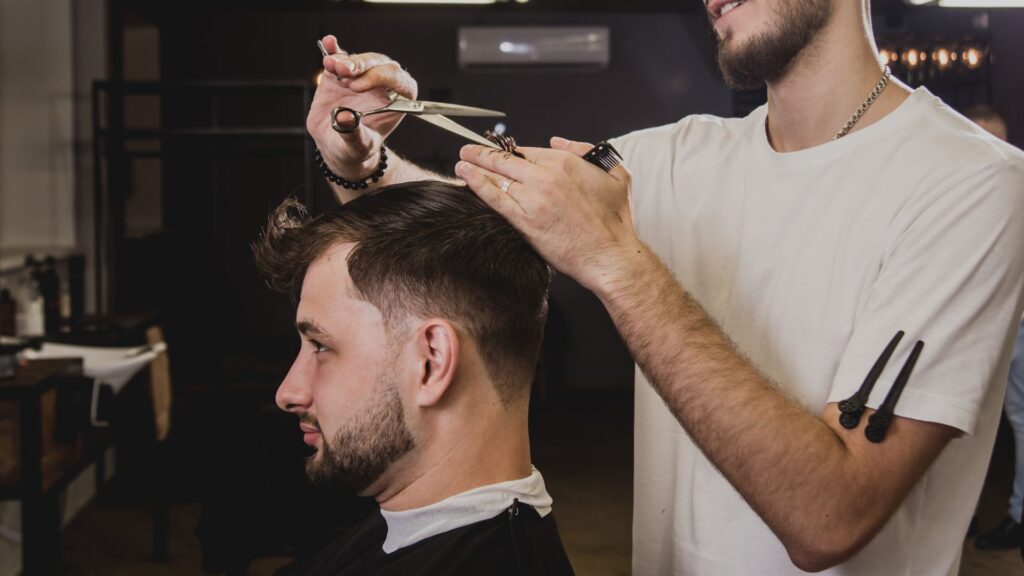
How Texture Affects Long Haircut Shape, Weight, and Layering Decisions
The longer the hair, the more its natural texture asserts itself. Straight hair at longer lengths can look flat without layers, while curly hair at longer lengths gains significant weight, which naturally loosens the curl pattern lower down the head. Barbers working on longer cuts pay close attention to where weight accumulates and layer strategically to prevent a bottom-heavy, triangular silhouette.
Long Hair and the Fade: Where Texture Makes or Breaks the Blend
Combining a long haircut on top with a fade underneath is one of the trickier requests in barbering, since the contrast between short and long sections has to blend seamlessly regardless of texture. Curly and coily hair often creates a more dramatic visual contrast at this blend point, requiring extra care to avoid a jarring line between the fade and the longer hair above it.
Maintenance Schedules for Long Hair Across Hair Types
Straight long hair typically needs trims every 8 to 10 weeks to maintain shape, since split ends show quickly. Curly and coily long hair can often stretch to 10 to 12 weeks between trims, since the curl pattern helps disguise split ends longer, though moisture maintenance becomes more critical at length.
The Children Haircut: Adapting Technique for Young Hair
Cutting a Children Haircut requires a different mindset entirely, blending technical adjustment with patience and psychology.
How Children’s Hair Texture Differs From Adult Hair
Children’s hair is often finer and less dense than adult hair, even when the eventual adult texture will be thicker or curlier. Barbers account for this by using lighter clipper pressure and being conservative with any thinning techniques, since young hair can look overly sparse if treated the same as mature adult hair.
Managing Movement, Fear, and Fine Hair in the Chair
Beyond texture, cutting a child’s hair means managing a moving target, sometimes literally. Barbers who work well with kids develop techniques for quick, efficient cutting that minimizes time in the chair, along with a calm, reassuring presence that helps nervous children sit still.
Age-Appropriate Styles Adapted by Hair Type
Straight-haired kids often do well with simple, low-maintenance cuts like a classic crew or bowl-inspired style, while curlier-haired children benefit from cuts that let natural curl pattern show without requiring complex daily styling that a young child (or their parent) isn’t equipped to manage.
Tools of Adaptation: How Equipment Choice Changes by Hair Type
The tools in a barber’s kit aren’t interchangeable across every head that sits in the chair.
Clippers, Guards, and Blade Selection by Texture
Coarser, curlier hair often requires clippers with more powerful motors to avoid snagging or bogging down mid-cut. Guard length selection also shifts, since curlier hair needs a longer guard to achieve the same finished appearance as straight hair, due to shrinkage.
Scissors and Shears: When and Why the Tool Changes
Standard shears work well on straight and wavy hair for precision cutting, while curly and coily hair often benefits from specific curl-cutting shears designed with a slight curve that follows the natural bend of the strand.
Product Selection Before, During, and After the Cut
| Hair Type | Pre-Cut Product | Post-Cut Product |
| Straight | Lightweight detangler | Light pomade or wax |
| Wavy | Sea salt spray or light cream | Texturizing paste |
| Curly | Leave-in conditioner | Curl-defining cream |
| Coily | Heavy leave-in or oil | Butter-based moisturizer |
Fades Across Hair Types: The Most Technically Demanding Adaptation
If there’s one service that separates a good barber from a great one, it’s the fade, since almost nothing exposes texture-related skill gaps faster.

Fade Mechanics on Straight Hair vs. Curly Hair vs. Coily Hair
On straight hair, a fade blend is largely about clipper angle and guard transition, since the hair itself offers no texture to hide seams. On curly and coily hair, the natural texture can actually help disguise minor blending imperfections, but it also hides mistakes until the hair fully dries and settles, sometimes revealing problems after the client has already left the chair.
Common Fade Mistakes by Hair Type and How Pros Correct It
A frequent mistake on straight hair fades is a visible line where guard lengths change, since there’s no texture to soften the transition. On curly hair, a common mistake is fading too aggressively without accounting for how much the curl will spring up once dry, leaving the fade higher and more dramatic than intended.
Skin Fades, Taper Fades, and Drop Fades: Which Works Best for Which Texture
- Skin fade: Works on all textures but shows the most contrast on straight hair
- Taper fade: A safer, more forgiving option for coily hair, since it involves less dramatic contrast
- Drop fade: Particularly popular on curly and coily hair, since the curve follows the natural head shape and complements curl volume
Barber Communication: Getting the Right Cut Starts Before the Clippers Do
No amount of technical skill compensates for a miscommunication about what the client actually wants.
The Vocabulary Gap Between Client and Barber
Clients often use vague terms like “not too short” or “just clean it up,” which mean different things to different people. A skilled barber asks clarifying questions to pin down specifics, translating vague requests into concrete guard lengths and shapes.
How to Describe Your Hair Type and Desired Result Clearly
Coming prepared with knowledge of your own hair’s behavior, whether it shrinks significantly, how it responds to humidity, how fast it grows, gives your barber crucial information that speeds up the reading process and reduces guesswork.
Reference Photos: Why They Help and Where They Fall Short
Reference photos are useful for establishing general shape and style direction, but they fall short when the model in the photo has significantly different hair type than the client’s own hair. A curly-haired client showing a photo of a straight-haired model needs the barber to translate that shape into what’s achievable with their actual texture.
Common Mistakes When Cutting Different Hair Types
Even experienced barbers can slip up when texture-specific nuance gets overlooked.
The Top Mistakes Made on Straight Hair, Wavy Hair, and Curly Hair
Straight hair mistakes usually involve overly blunt, weighty cuts that look heavy rather than sleek. Wavy hair mistakes often stem from ignoring the wave pattern entirely and cutting it like straight hair. Curly hair mistakes typically involve underestimating shrinkage and cutting too short.
What Happens When a Barber Doesn’t Account for Texture
The most common outcome is a haircut that looked correct in the chair but transforms into something unrecognizable once the client washes and dries their hair at home, since the salon or shop environment doesn’t always reflect how hair will behave in daily conditions.
How to Course-Correct After a Bad Cut by Hair Type
Straight hair mistakes can often be blended out with a follow-up trim within a couple weeks. Curly and coily hair mistakes involving over-shrinkage sometimes require patience, letting hair grow out enough to reshape, since there’s no way to add length back once it’s cut too short.
Pricing, Time, and Value: Why Hair Type Affects the Bill
Not all haircuts take the same amount of time or skill, and pricing often reflects that reality.
Why Curly and Coily Cuts Often Take Longer and Cost More
Cutting curly and coily hair typically requires more detangling, more careful section-by-section work, and more frequent pauses to check how curls are settling. This added time is a legitimate factor in pricing, not simply an arbitrary upcharge.
Pricing Benchmarks by Service and Texture Type
| Service | Straight/Wavy Average | Curly/Coily Average |
| Basic Haircut | 25-40 | 35-60 |
| Fade | 30-45 | 40-65 |
| Long Haircut/Trim | 35-50 | 45-70 |
Pricing varies significantly by region and shop, but the general pattern of curly and coily cuts commanding higher prices holds across most markets.
When to Splurge on a Specialist vs. a Generalist
If your hair type is straight or lightly wavy, most competent generalist barbers can handle your needs well. If you have tightly curly or coily hair, seeking out a barber with specific, demonstrated experience in that texture is often worth the extra cost and search time.
The Future of Hair-Type-Inclusive Barbering
The barbering profession continues evolving toward greater inclusivity across all hair textures.
How Barber Education Is Evolving to Cover All Textures
Many barber schools have historically under-taught curly and coily hair cutting techniques, but that’s shifting as demand for texture-inclusive education grows and more programs add dedicated curriculum around diverse hair types.
Trends in Texture-Specific Products and Tools
Product lines specifically formulated for curly and coily hair have expanded significantly, giving barbers more specialized options to recommend for pre-cut prep and post-cut styling.
Building a Shop Culture That Welcomes Every Hair Type
Shops that actively train staff across all textures and stock products for diverse hair types send a clear signal that every client, regardless of hair type, will receive equally skilled service.
What You Should Do Before Your Next Appointment
Walking into your next haircut with a bit of hair type knowledge changes the entire experience. Instead of hoping your barber guesses correctly, you become an active participant in getting the result you actually want.
Your Pre-Visit Checklist by Hair Type
- Know your general hair type and how much your hair shrinks when it dries
- Bring reference photos, but be ready to discuss how your texture might change the final look
- Communicate any past haircut disappointments and why they happened
- Ask questions about tools and techniques your barber plans to use
How to Build a Long-Term Relationship With Your Barber
The best haircuts often come from an ongoing relationship where your barber learns your hair’s specific quirks over multiple visits. Sticking with one skilled professional, rather than bouncing between different shops, pays off significantly over time.
Frequently Asked Questions Answered from Behind the Chair
Does my hair type affect how often I need a haircut?
Yes. Straight hair typically needs trims every 3 to 4 weeks to maintain a fade or short style, while curly and coily hair can often stretch to 4 to 6 weeks between cuts, since curl pattern disguises growth longer.
Why did my barber cut my curly hair dry instead of wet?
Dry cutting lets the barber see exactly how your curls fall and behave in their natural state, avoiding the shrinkage miscalculations that can happen when curly hair is cut wet and then shrinks further once dry.
Can any barber cut coily hair well, or do I need a specialist?
While technique can be learned by any skilled barber, coily hair specifically benefits from someone with real experience and training in that texture, since mistakes are harder to fix and shrinkage miscalculations are common among less experienced barbers.
Why does my fade look different than my friend’s fade even with the same guard length?
Hair texture, density, and curl pattern all affect how a fade visually reads, even with identical guard lengths used during the cut.
Is it normal for curly cuts to cost more than straight hair cuts?
Yes, this is common and typically reflects the additional time, detangling, and careful technique required, rather than an arbitrary price difference.
How do I explain my hair type to a new barber?
Describe how your hair behaves when fully dry, including how much it shrinks, how it responds to humidity, and any specific concerns from past haircuts, to give your barber a clear starting point.
Will my wavy hair look the same as the reference photo I bring in?
Not exactly, since wave pattern, density, and how your hair naturally falls will all influence the final result differently than a model with different hair type.
Can thin hair support a long haircut?
Yes, but it typically requires careful layering and styling techniques to create the appearance of volume, since thin hair naturally lacks the density needed to hold significant length without looking flat.
Conclusion
A great haircut isn’t about forcing your hair into someone else’s mold. It’s about a barber who understands your specific texture well enough to shape a style that works with your hair, not against it. Find someone who takes the time to read your hair before they ever pick up the clippers, and you’ll walk out looking sharp every single time.