

There’s a sound I’ve heard ten thousand times, and I still love it. It’s the soft scrape of a sharp blade moving across a well-prepped cheek. It isn’t harsh. It’s more of a whisper, like a page turning in a quiet library.
Before that sound comes the ritual. The leather chair tips back. A steaming towel, scented faintly with eucalyptus, settles over your face. You breathe in, the world goes quiet, and for two minutes nobody needs anything from you. Then the warm lather goes on with a badger brush, the steel comes out, and the work begins.
I had a client years ago who came in for a haircut every three weeks and never once let me shave him. “I’ve got a razor at home,” he’d say. One afternoon I talked him into a hot towel shave. When he sat up, he ran his palm along his jaw, frowned, and then laughed. “My razor’s not the problem, is it?” No, it wasn’t. His prep was.
Why Prep Matters More Than the Razor
Most men blame the blade when a shave goes wrong. The burn, the bumps, the little red dots on the neck: it must be the razor’s fault. So they buy a new one with more blades and a fancier handle.
Here’s the straight talk. A great razor on unprepared skin still gives you a rough shave. A decent razor on well-prepared skin gives you a smooth one. Prep is the foundation. The razor is just the roof.
Think of it like painting a room. The paint matters, sure. But the pros spend most of their time sanding, cleaning and taping. Skip that, and the most expensive paint in the store still peels. Your face works the same way.
How to Use This Checklist
This guide walks you through every stage of a better shave, from the night before to the last splash of aftershave. You’ll learn:
- What’s happening on your skin when a blade meets a whisker
- How to prep your face with heat, cleansing and pre-shave products
- How to choose lather and razors that suit your skin and budget
- How to shave, finish and fix problems like burn, bumps and nicks
Whether you shave every day, once a week, or you’re a dad teaching your son his first shave, you’ll find something useful here. Before we talk technique, though, it’s worth knowing how men got here.
A Short History of the Close Shave
Copper, Flint and Bronze
Men have been scraping hair off their faces for a very long time. Archaeologists have found sharpened flint and shells that early humans likely used for shaving. By the fourth millennium BCE, Egyptians were using copper razors, and later bronze ones. A smooth face signaled cleanliness and status.
The ancient Greeks and Romans took it further. According to the historian Plutarch, Alexander the Great ordered his soldiers to shave so enemies couldn’t grab their beards in close combat. In Rome, a young man’s first shave was celebrated as a coming-of-age ceremony, and the shavings were sometimes offered to the gods.
Picture that next time you nick yourself on a Tuesday morning. Somewhere back there, your great-great-great-grandfather was doing this with a sharpened rock.
From Straight Razor to Safety Razor
For centuries, the straight razor ruled. Sheffield, England became famous in the 1700s and 1800s for its fine steel blades. A straight razor in skilled hands gives a beautifully close shave. In unskilled hands, it can give you a story you’ll tell for years.
That changed when King Camp Gillette received a patent for his safety razor with a disposable double-edge blade in 1904. The guard between blade and skin made home shaving far safer. During World War I, Gillette supplied millions of razors and blades to American soldiers, and men came home with a habit for life.
The electric razor followed when Jacob Schick brought his dry shaver to market in 1931. Multi-blade cartridges arrived later and reshaped the bathroom shelf once again.
The Barbershop Shave Through the Decades
| Era | Milestone | What It Meant for Your Face |
| Around 3000 BCE | Egyptian copper razors | Shaving becomes a sign of status |
| 1700s to 1800s | Sheffield steel straight razors | Sharper, longer-lasting blades |
| Late 1800s | Barbershop shaves become a daily ritual | Hot towels, mugs and brushes |
| 1904 | Gillette safety razor patent | Safe home shaving takes off |
| 1931 | Schick electric razor goes on sale | Dry shaving becomes an option |
| 1971 | First twin-blade cartridge razor | Cartridges begin to dominate |
| 1970s | Disposable plastic razors spread | Cheap, throwaway convenience |
| 1990s to 2000s | Three, four and five-blade cartridges | Close shaves, but more irritation for some |
| 2010s to 2020s | Safety razor and hot towel revival | Men return to the ritual |
In the early 1900s, many men visited the barbershop several times a week just for a shave. The shop smelled of bay rum, witch hazel and talc. Mugs with each customer’s name lined the wall. Some shops still keep a few of those mugs on a high shelf, and I’ll admit mine does too.
History shows how we shave. Biology shows why the prep matters so much.
What’s Really Happening on Your Face
The Toughness of a Single Whisker
A whisker looks soft. It isn’t. Razor engineers have long repeated a comparison that a dry beard hair is about as tough as copper wire of the same thickness. That’s why dragging a blade across dry stubble feels like dragging a rake across gravel.
Most men have somewhere between 7,000 and 15,000 whiskers on their face, according to commonly cited dermatology estimates. Each one grows roughly half a millimeter a day. By morning, you’ve got thousands of tiny wires waiting for your blade.
The good news is that whiskers soak up water. Gillette’s research team has long reported that beard hair needs about two to three minutes of steady contact with warm water to soften fully. Softened hair cuts with far less force, which means less tugging, less pulling and less irritation.
Skin Layers and the Razor’s Path
Your skin’s outer layer, the stratum corneum, is a thin sheet of flattened, dead cells. It acts like a shield. Every time a blade passes over your face, it shaves off a little of that shield along with the hair.
That’s normal. The trouble comes when you scrape too much away. Too many passes, too much pressure or a dull blade can strip that layer thin, leaving the living skin beneath exposed and angry. That’s the hot, stinging feeling we call razor burn.
Good prep protects that layer. Warm water plumps it. Lather cushions it. A sharp blade glides over it instead of chewing through it. You’re not just preparing the hair. You’re protecting the skin.
Grain, Growth Direction and the Tricky Neck
Every beard has a grain, the direction the hairs grow. On the cheeks, it usually runs downward. On the neck, it can run in almost any direction: sideways, upward, even in swirls.
Here’s an experiment. Run your fingertips slowly over your jaw and neck after a day’s growth. Where it feels smooth, you’re moving with the grain. Where it feels rough, you’re moving against it.
The neck is where most men run into trouble. A single patch can change direction two or three times within a few inches. Shave the whole neck in one direction and you’re cutting against the grain in some spots, which raises the risk of irritation. Knowing your grain is a bit like knowing the slope of a putting green. Read it first, then make your stroke.
Your whiskers are only half of the equation. Your skin type is the other half.
Know Your Skin Before You Shave
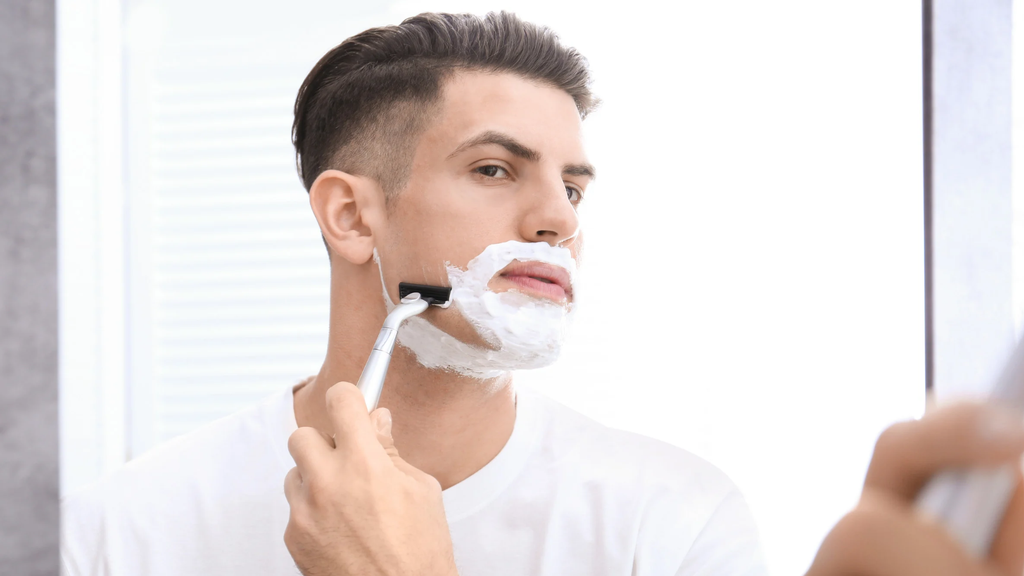
Oily, Dry, Combination and Sensitive
Your skin type shapes every product choice you’ll make. A 2019 review by dermatology researcher Miranda Farage found that roughly half of men report some degree of sensitive skin, so if your face reacts easily, you’re far from alone.
| Skin Type | How It Feels | Shave Prep Priority | Watch Out For |
| Oily | Shiny by midday, larger pores | Thorough cleansing | Heavy oils that clog pores |
| Dry | Tight after washing, flaky patches | Moisture before and after | Alcohol-heavy aftershaves |
| Combination | Oily forehead, dry cheeks | Balanced, gentle products | Over-cleansing dry areas |
| Sensitive | Stings, flushes, reacts easily | Fragrance-free everything | Menthol, strong scents, too many passes |
| Normal | Comfortable most of the day | Consistency | Getting lazy with prep |
If you’re not sure what you’ve got, wash your face with a gentle cleanser, pat it dry, and wait an hour without applying anything. Shiny all over? Oily. Tight and dull? Dry. Shiny forehead, tight cheeks? Combination. Red or itchy? Sensitive.
Curly Beards and Bump-Prone Skin
Men with curly or coily beards face an extra challenge. When curved hair is cut very close, the sharp tip can curl back and pierce the skin as it grows. That’s pseudofolliculitis barbae, better known as razor bumps.
According to the American Osteopathic College of Dermatology, this condition affects an estimated 45 to 83 percent of Black men who shave regularly. It can also affect any man with tightly curled facial hair. The American Academy of Dermatology notes that untreated bumps can lead to dark spots and even scarring.
For bump-prone skin, prep isn’t optional. Softening, a single pass with the grain and avoiding a skin-tight shave make a real difference. Some men do better with a single-blade safety razor or a close electric trim than with a multi-blade cartridge. We’ll come back to this in detail.
Acne, Eczema and When to See a Dermatologist
Shaving over active acne is tricky. A blade can slice the tops off pimples, spreading bacteria and causing more irritation. If you’re breaking out, shave gently around inflamed spots, use a fresh blade, and consider skipping a day.
Eczema and seborrheic dermatitis, which often shows up as flaky, red patches near the eyebrows, sides of the nose and beard area, also need care. Fragrance-free products and fewer passes help.
When should you see a dermatologist? If bumps last more than a few weeks, if you see pus or darkening scars, or if your skin burns after every shave no matter what you change. A barber can help you refine technique, but persistent skin conditions deserve a medical opinion.
Once you know your skin, the work can start the night before.
The Night Before
Gentle Exfoliation, Not Sandpaper
Exfoliation clears away dead skin cells so whiskers can stand up and the blade can glide. It also helps free hairs that might be starting to curl back under the surface.
There are two main types, and they work differently:
| Factor | Physical Exfoliant (Scrub) | Chemical Exfoliant (Acid) |
| How it works | Grains rub away dead cells | Acids loosen cell bonds |
| Common ingredients | Jojoba beads, fine sugar | Glycolic, salicylic or lactic acid |
| Best for | Normal and oily skin | Bump-prone and sensitive skin |
| Risk | Micro-scratches if too rough | Stinging if overused |
| How often | 1 to 2 times a week | 2 to 3 times a week, often at night |
The American Academy of Dermatology warns that over-exfoliating can cause redness and irritation, so more is not better. I tell clients to exfoliate the night before a shave, not right before. That gives your skin time to settle.
For bump-prone skin, a gentle chemical exfoliant is often the better pick. A study published in the journal Cutis found that a glycolic acid lotion helped reduce razor bumps in men with pseudofolliculitis barbae.
Hydration From the Inside and Out
Dry, tight skin shaves poorly. Hydrated skin is more flexible and more forgiving under the blade.
Start with a light moisturizer before bed, especially in winter or if you run the heat at night. Look for ingredients like glycerin, hyaluronic acid or ceramides. These help skin hold onto water.
Drinking water matters too, though not as much as people think for skin specifically. The bigger wins usually come from what you put on your face and avoiding long, scalding showers that strip natural oils.
Trimming Long Stubble First
If you’ve let your face go for a week or more, don’t go straight to the razor. Long hair clogs blades, pulls at the skin and turns a shave into a wrestling match.
Trim it down first with clippers or a beard trimmer, leaving a short, even stubble. After a vacation or a long stretch of Beard Growth, this one step can save you twenty minutes and a lot of irritation.
I tell clients to do this trim the evening before, or at least a few minutes before showering. A trimmed face also lets you see your grain more clearly. Now, on to the morning, where heat does most of the heavy lifting.
Warm Water, Clean Skin and the Hot Towel
Why Heat Softens the Beard
Warm water does three things. It softens whiskers so they cut easily. It loosens the oils on your skin so lather can grip. And it relaxes the skin so the blade can follow your face’s curves.
Hot water isn’t better, though. Water that’s too hot can dry out skin and make it flush, especially if you’re sensitive. Aim for comfortably warm, the kind of temperature you’d use to warm a baby’s bottle on your wrist.
Remember Gillette’s figure: about two to three minutes of steady moisture. Splashing your face twice in the sink for ten seconds won’t get you there.
Shower Shave vs. Sink Shave
| Factor | Shaving After a Shower | Shaving at the Sink |
| Beard softening | Excellent, steam and time | Good if you use a hot towel |
| Visibility | Needs a fog-free mirror | Clear mirror, easy view |
| Cleanup | Easy, rinses away | Requires wiping the sink |
| Control | Can feel rushed or awkward | Steadier, more deliberate |
| Best for | Quick daily shaves | Careful, close shaves |
Many men get the best of both by shaving right after a warm shower, at the sink, while their face is still damp and soft. It’s like stretching after a warm-up jog instead of before it. Your muscles, and your whiskers, are already ready.
Cleanse Without Stripping
Washing before you shave clears away oil, sweat and dead skin that can dull a blade and trap bacteria. But harsh cleansers can strip the skin and leave it vulnerable.
| Cleanser Type | Best For | Feel After Washing | Avoid If |
| Gel cleanser | Oily, normal skin | Fresh, clean | Very dry skin |
| Cream cleanser | Dry, sensitive skin | Soft, comfortable | Very oily skin |
| Foaming cleanser | Combination skin | Light, airy | Easily irritated skin |
| Bar soap (regular) | Body, not face | Often tight | Shaving the face regularly |
| Salicylic acid wash | Acne-prone, oily skin | Clarified | Using daily with other acids |
Bar soap vs. a facial cleanser is a comparison worth mentioning. Many traditional bar soaps are more alkaline than your skin. That’s fine for your arms. On your face right before a blade passes over it, it can leave things tight and ready to sting. A gentle facial cleanser is the better pick.
Massage it in with your fingertips for about thirty seconds, working against the grain to help lift the hairs. Then rinse with warm water, and leave your face damp.
Building Your Own Hot Towel at Home
You don’t need a barbershop towel warmer to get the benefits. Here’s how I teach it:
- Soak a small cotton hand towel in hot tap water, or dampen it and microwave it for 20 to 30 seconds.
- Test the heat on your wrist first. It should feel hot, not scalding.
- Wring it out so it isn’t dripping.
- Lie back or lean over the sink and drape it over your lower face, leaving your nose clear.
- Press gently with your palms. Hold for one to two minutes.
- Repeat once if your beard is coarse.
A drop of eucalyptus or lavender oil in the water adds a little barbershop feel, but skip it if your skin is sensitive. Heat has done its job. Next comes the step most men skip.
Pre-Shave Oils, Creams and Primers
What a Pre-Shave Actually Does
A pre-shave is a thin layer that goes on before your lather. Its job is to add slip, so the blade glides instead of drags. It also helps lock in the moisture from your hot towel.
Is it necessary? Not for everyone. Men with fine whiskers and easygoing skin can often skip it. But if you have a coarse beard, sensitive skin or a habit of razor burn, a pre-shave can be the difference between “fine” and “great.”
It’s like the base coat on a car. You won’t see it when the job’s done, but it’s why the finish lasts.
Oil vs. Cream
| Factor | Pre-Shave Oil | Pre-Shave Cream |
| Texture | Thin, slick | Rich, cushioned |
| Glide | Excellent | Good |
| Best for | Coarse beards, dry skin | Sensitive or oily skin |
| Amount needed | 3 to 4 drops | Pea to almond size |
| Downside | Can clog razors if overused | Slightly less glide |
| Feel after shave | Soft, sometimes slightly oily | Light, comfortable |
Apply either one to damp skin. Massage it in against the grain for about 30 seconds, then go straight to lather. Don’t wipe it off.
Ingredients Worth Knowing
| Ingredient | What It Does | Who It Helps |
| Glycerin | Draws water into skin | Almost everyone |
| Jojoba oil | Close to skin’s natural oil, adds glide | Dry and normal skin |
| Castor oil | Thick slip, cushions the blade | Coarse beards |
| Aloe vera | Soothes and calms | Sensitive skin |
| Allantoin | Calms irritation | Razor burn sufferers |
| Shea butter | Rich moisture | Dry, flaky skin |
| Menthol | Cooling tingle | Normal skin only, can sting sensitive skin |
| Synthetic fragrance | Scent | Skip it if you react easily |
If you’ve had bad reactions before, read labels. Fragrance and menthol are the two most common troublemakers I see in the chair. Now let’s build the lather that sits on top.
Lather That Works for You
Soap, Cream, Gel and Canned Foam
Lather does more than look good. It holds water against your whiskers, cushions the blade and shows you where you’ve already shaved.
| Lather Type | Cushion | Glide | Prep Time | Best For |
| Traditional shaving soap | High | High | 2 to 3 minutes with a brush | Ritual lovers, coarse beards |
| Shaving cream (tube or tub) | High | High | 1 to 2 minutes | Most men |
| Shaving gel | Medium | Medium to high | Under a minute | Quick shaves, seeing your lines |
| Canned foam | Low to medium | Medium | Seconds | Travel, emergencies |
| Brushless cream | Medium | Medium | Under a minute | Men without a brush |
Canned foam is mostly air. It works, but it dries out fast and gives less protection. If your skin is sensitive, upgrading from canned foam to a good cream is often the cheapest fix you’ll ever make.
Brush vs. Fingers
| Factor | Shaving Brush | Fingers |
| Lather quality | Thick, rich, warm | Thinner, quicker |
| Lifts whiskers | Yes, bristles push hair up | Less so |
| Gentle exfoliation | Mild | None |
| Time | 1 to 3 minutes | 30 seconds |
| Cost | $15 to $80+ | Free |
A brush does something your fingers can’t. Its bristles sweep under the whiskers and lift them away from the skin, so the blade gets a cleaner cut. Synthetic brushes have come a long way. They’re soft, dry fast and are a good choice for most men.
Building Lather Step by Step
Here’s the method I use in the chair:
- Soak your brush in warm water for a minute.
- Shake out most of the water, leaving it damp, not dripping.
- Load the brush by swirling it on soap for 20 to 30 seconds, or by adding an almond-sized dab of cream.
- Whip it in a bowl, mug or your palm in small circles until it forms soft peaks, like whipped cream.
- Apply in circles across your beard, then finish with strokes in one direction to lay it smooth.
- Let it sit for about 30 seconds while you rinse your razor.
Too dry and bubbly? Add a few drops of water. Too thin and runny? Add more soap or cream. Getting lather right is like getting coffee right. It takes a few mornings to find your ratio. Lather’s ready. Now let’s pick up the steel.
Choosing and Caring for Your Razor
Straight, Safety, Cartridge and Electric
| Razor Type | Closeness | Learning Curve | Irritation Risk | Ongoing Cost |
| Straight razor | Closest | Steep | Low with skill, high without | Very low (stropping, honing) |
| Safety razor (double-edge) | Very close | Moderate | Low | Very low, blades cost cents |
| Cartridge razor (multi-blade) | Very close | Easy | Moderate, higher for bump-prone skin | High, cartridges add up |
| Disposable razor | Moderate | Easy | Moderate to high | Moderate |
| Electric foil shaver | Close | Easy | Low | Low after purchase |
| Electric rotary shaver | Moderate | Easy | Low | Low after purchase |
Safety razor vs. cartridge razor is the comparison I’m asked about most. Multi-blade cartridges are forgiving and easy, which is great. But each extra blade cuts the hair a little lower, sometimes slightly below the skin line. For men prone to bumps, that’s exactly the wrong outcome. A single sharp blade with good technique often leaves the skin calmer.
Blade Freshness and Why It Matters
A dull blade tugs instead of slices. It skips, catches and needs extra pressure, which means extra irritation.
The American Academy of Dermatology recommends changing your blade or tossing a disposable razor after five to seven shaves. If you feel pulling, stop and swap it, even if it’s newer than that.
| Blade Sign | What It Means | What to Do |
| Smooth, quiet glide | Blade is sharp | Keep going |
| Tugging on whiskers | Edge is dulling | Replace soon |
| Need to press harder | Edge is dull | Replace now |
| Rust spots or discoloration | Blade is damaged | Replace and dry better |
| Nicks in the usual spots | Possibly a damaged edge | Inspect and replace |
Cleaning and Storage
Rinse your razor under hot water after every stroke or two. Hair and lather build up between blades and keep the edge from touching skin.
After shaving, rinse it well, shake it off and let it dry upright somewhere with airflow. The AAD advises storing razors in a dry area, since a damp shower caddy is a great place for bacteria and rust. Don’t wipe a blade with a towel. It dulls the edge faster than you’d think.
Brushes need care too. Rinse out all the lather, squeeze gently, and hang or stand them with bristles down or facing air so water doesn’t sit in the base. Your tools are ready. Time to shave.
The Shave Itself: A Pass-by-Pass Guide
Map Your Grain
Before you lather, take sixty seconds to map your grain. Run your fingers over every zone of your face and neck and note which way the hair grows.
| Face Zone | Common Grain Direction | Notes |
| Upper cheeks | Downward | Usually the easiest zone |
| Lower cheeks and jaw | Downward or slightly angled | Watch the jawline curve |
| Mustache | Downward and outward | Hair is often coarser |
| Chin | Down, sometimes sideways | Tight curves, go slowly |
| Upper neck | Varies widely | Can swirl or grow sideways |
| Lower neck | Often upward or sideways | Most common irritation zone |
Some men take a photo or draw a simple map the first time. It sounds silly. It works. Once you know it, you won’t forget it.
The First Pass With the Grain
Your first pass should go with the grain, in the direction your hair grows. This removes most of the length with the least trauma to the skin.
With the grain vs. against the grain is the heart of shaving comfort:
| Factor | With the Grain | Against the Grain |
| Closeness | Good | Very close |
| Irritation risk | Low | Higher |
| Risk of ingrown hairs | Low | Higher, especially for curly hair |
| AAD recommendation | Recommended | Not recommended for sensitive or bump-prone skin |
| Best use | Every shave | Occasional, for experienced shavers with tough skin |
The American Academy of Dermatology specifically recommends shaving in the direction of hair growth. For most men, one pass with the grain is enough for a clean, comfortable look.
Shave in short strokes, about an inch or two at a time. Rinse your blade often. Start with the cheeks, where hair is softest, and save the mustache and chin for last so they have extra soaking time under the lather.
Stretch, Angle and Pressure
Three small things decide whether a stroke is smooth or rough.
Stretch. Use your free hand to gently pull the skin taut, especially on the neck and jaw. Flat skin gives the blade an even surface. It’s like smoothing a bedsheet before you iron it.
Angle. With a safety razor, hold the blade at about 30 degrees to your skin. Start with the handle nearly flat against your cheek, then tilt it down until the blade just begins to cut. Cartridges have a pivoting head that finds the angle for you.
Pressure. Use almost none. Let the weight of the razor do the work. If you’re pressing, your blade is dull, your prep was short or you’re rushing. I tell younger clients to imagine shaving a balloon. Press too hard and it pops.
The Second Pass, and When to Skip It
If you want a closer finish, re-lather and make a second pass across the grain, moving sideways. This gets closer without the full risk of going against it.
Skip the second pass if:
- Your skin is already pink or stinging
- You’re prone to razor bumps
- You have an important event tomorrow and can’t afford irritation
- You’re short on time and tempted to rush
Experienced shavers with tough skin may add a careful third pass against the grain. Most men don’t need it. A smooth face with a hint of shadow by evening beats a baby-smooth face with a red, angry neck. With the blade down, the last step is often the most neglected.
After the Blade

The Cool Rinse
Rinse your face with cool water when you finish. It washes off leftover lather, calms warmth in the skin and simply feels good, like stepping into shade on a hot day.
Pat dry with a clean towel. Don’t rub. Your skin has just lost a thin layer of its outer shield, and rubbing it with a rough towel is like sanding wood you just finished.
Then run your fingers over your face with the grain. Missed patches? Leave them for tomorrow, or touch them up lightly with a little fresh lather. Never dry-shave a spot you missed.
Aftershave Splash vs. Balm
| Factor | Alcohol-Based Splash | Aftershave Balm |
| Feel | Sharp sting, quick cool | Soft, soothing |
| Moisture | Low, can dry skin | High |
| Antiseptic action | Some | Varies by ingredients |
| Best for | Oily, resilient skin | Dry, sensitive or bump-prone skin |
| Classic scent | Strong | Usually lighter |
| Barbershop nostalgia | Very high | Moderate |
The splash is the old-school classic. That slap and sting has been a barbershop ritual for a century. For many men, though, a balm is kinder to the skin. Look for glycerin, aloe, allantoin or niacinamide.
Witch hazel is a gentle in-between option. It’s a mild astringent that tightens without the full sting of alcohol. An alum block also has a long history in barbershops. Rub it lightly over damp skin, and it can help with tiny nicks and give you feedback: where it stings, you shaved too close.
Treating Nicks and Weepers
Even pros get nicked. A small nick usually stops bleeding on its own within a few minutes. Some barbers call these weepers, the tiny dots that keep oozing a little longer than they should.
- Rinse with cool water.
- Press a clean tissue or cotton pad firmly on the spot for one to two minutes.
- Use a styptic pencil or alum block for stubborn spots. It’ll sting for a second.
- Let it close before applying balm directly to it.
The old toilet-paper-on-the-chin trick works too, as long as you remember to take it off before you walk out the door. I’ve seen more than one man show up to a job interview with a little paper flag on his jaw. Next up, the mistakes I see most often.
Mistakes That Ruin a Good Shave
Shaving Dry or in a Rush
The worst shave in the world is the one you squeeze into the car’s rearview mirror with a dry disposable. Dry whiskers resist the blade, dry skin can’t cushion it, and rushing means more pressure and more mistakes.
If you’re short on time, skip the shave. A day of stubble is better than a week of irritation. Or keep a cordless electric shaver in your bag for emergencies.
Pressing Too Hard
Pressure is the most common error I fix in the chair. Men press because they think it gets a closer shave. It doesn’t. It pushes the blade deeper into the skin, scrapes away more of the protective layer and causes burn.
Watch for these signs you’re pressing too hard: redness right after shaving, stinging when you rinse, or visible lines where the blade edge pressed. Ease up, slow down and let a sharp blade do its job.
Dull Blades and Dirty Brushes
| Mistake | What It Causes | The Fix |
| Using a blade past 7 shaves | Tugging, burn | Replace on schedule |
| Storing razor in the shower | Rust, bacteria | Dry upright outside the shower |
| Never cleaning the brush | Bacteria, stiff bristles | Rinse well, dry bristles down |
| Sharing razors | Infection risk | Never share blades |
| Using body soap on the face | Tightness, sting | Use a facial cleanser |
| Skipping post-shave moisturizer | Dryness, flaking | Balm or moisturizer every time |
| Shaving over active breakouts | More irritation | Shave around them or skip a day |
Sharing razors is worth pausing on. Blades can carry tiny amounts of blood, and the AAD and other health organizations advise against sharing. That goes for fathers and sons too. Get your boy his own razor.
Razor Burn vs. Razor Bumps
Men use these terms like they’re the same thing. They’re not.
| Factor | Razor Burn | Razor Bumps (Pseudofolliculitis Barbae) |
| When it appears | Minutes after shaving | Hours to days after shaving |
| What it looks like | Red, flat rash | Raised bumps, sometimes with pus |
| How it feels | Stinging, burning | Tender, itchy |
| Main cause | Friction, dull blade, pressure | Curly hairs growing back into skin |
| Who gets it most | Anyone | Men with curly or coily beards |
| How long it lasts | A day or two | Can persist and scar if ignored |
| Best prevention | Prep, sharp blade, light pressure | Fewer passes, no stretching, avoid skin-close shave |
Note one twist for bump-prone skin: some dermatologists advise against stretching the skin too much, because the hair can retract below the surface after it’s cut. If you get bumps, ease off the stretch. Stories make these lessons stick better than tables do, so let me share a few.
Stories From the Chair

The Groom Who Shaved Too Late
A young groom came in the morning of his wedding with a red, blotchy neck. He’d decided to give himself “the closest shave of his life” at 6 a.m. with a brand-new five-blade cartridge. Three passes, against the grain, no pre-shave.
We had about four hours before the ceremony. I wrapped him in a cool towel, dabbed on an aloe balm and kept everything gentle. By the time photos started, the redness had faded to pink. He was lucky.
Now I tell every groom the same thing: do your close shave the night before, or come in two days ahead. Wedding mornings are for coffee and nerves, not experiments.
The Father Teaching His Son
A father brought in his fourteen-year-old with a tiny mustache shadow on his upper lip. “I want him to learn it right,” the dad said. “Nobody taught me. I figured it out with a lot of blood.”
I let the boy sit in the chair and walked him through each step: warm towel, cleanser, lather with a brush, short strokes with the grain, cool rinse, balm. His dad stood behind him, arms folded, smiling.
When the boy finished, he touched his upper lip and looked at his father. Not a word. Just a nod. Some lessons between fathers and sons don’t need many words. They need the right tools and a little patience.
The Man Who Thought Bumps Were Normal
A man in his thirties came in for a lineup and mentioned, almost in passing, that he’d had bumps on his neck since he was sixteen. “That’s just how it is for me,” he said.
We talked. He shaved daily with a multi-blade razor, against the grain, stretching his skin hard. I suggested a few changes: a glycolic acid toner at night, a single-blade safety razor, one pass with the grain, no heavy stretching. I also recommended seeing a dermatologist for the dark spots.
Six weeks later, he came back with a neck I barely recognized. “Twenty years,” he said, shaking his head. “Twenty years I thought this was normal.” It’s not. And if it’s you, it doesn’t have to be.
The Firefighter and the Mask Seal
Some men don’t shave by choice. A firefighter I’ve cut for years has to stay clean-shaven for his breathing mask. OSHA’s respiratory protection standard, 29 CFR 1910.134, doesn’t allow tight-fitting respirators to be worn with facial hair that gets between the mask’s seal and the face.
That means he shaves every single shift, sometimes twice. When he started, his neck was raw most of the year. We built him a routine he could do in under ten minutes: shower, pre-shave oil, cream lather, one pass with a safety razor, balm.
“It’s not glamorous,” he told me once, “but my mask seals, and my neck doesn’t burn.” That’s what a good routine does. It turns a chore into something that just works. Speaking of what works, let’s talk about what it costs.
What a Better Shave Costs
Home Kit Budgets
You don’t need to spend a fortune. Here’s what a solid home setup looks like at three levels.
| Item | Budget Kit | Mid-Range Kit | Premium Kit |
| Razor | Cartridge, about $10 | Safety razor, $30 to $50 | Premium safety or straight razor, $80 to $200+ |
| Blades or cartridges | $20 to $40 per year | $10 to $20 per year | $10 to $30 per year, or stropping supplies |
| Lather | Shaving gel, $6 | Quality cream, $15 to $25 | Artisan soap, $25 to $40 |
| Brush | None | Synthetic, $15 to $30 | Premium synthetic or badger, $50 to $150 |
| Pre-shave | None | Oil, $15 to $20 | Oil and cream, $30 to $50 |
| Aftercare | Basic balm, $8 | Balm plus witch hazel, $20 to $30 | Balm, alum block, styptic, $40 to $60 |
| Startup cost | About $25 to $35 | About $100 to $150 | About $250 to $500+ |
Here’s something that surprises men. Over a few years, a mid-range safety razor setup often costs less than a budget cartridge routine. Cartridges are cheap to buy once and expensive to keep buying. Double-edge blades often cost well under a dollar each.
Barbershop Shave vs. Home Shave
| Factor | Barbershop Hot Towel Shave | Home Shave |
| Typical cost | $35 to $75 | Pennies to a few dollars per shave |
| Time | 30 to 45 minutes | 5 to 20 minutes |
| Closeness | Very close, straight razor | Depends on tools and skill |
| Relaxation | High, hot towels and massage | Varies |
| Skin assessment | Professional eye on your skin | Your own judgment |
| Best use | Special events, a reset, learning technique | Everyday maintenance |
A barbershop shave isn’t just about the result. It’s the leather chair, the hot towels, the smell of lather and the chance to let someone else take care of you for once. It also lets you see proper technique up close. Whether you ask a friend or type “haircut near me” into your phone, look for a shop that lists a hot towel shave on its menu and has barbers trained in straight razor work.
Gifts for Dads, Sons and Grooms
A good shave kit is one of the most useful gifts you can give a man. A few ideas:
- For a dad: A quality safety razor, a synthetic brush and a tub of cream he’ll use for months
- For a son’s first shave: A beginner kit with a gentle cream, a balm and a gift certificate for a lesson at a shop
- For a groom: A hot towel shave two days before the wedding, plus a travel kit for the honeymoon
- For a groomsmen gift: Engraved razors or brushes with matching balms
One of the sweetest gifts I’ve seen was a grandfather who passed down his old safety razor to his grandson, freshly cleaned, with a new pack of blades and a note: “Go slow. Same as I told your dad.” The boy kept the note in the box. Now let’s look at where shaving is headed.
Trends and Insights From Behind the Chair
The Return of the Safety Razor
Ten years ago, few men under forty had ever held a safety razor. Now they’re common again. Younger men like the lower waste, the lower cost per blade and the feeling of doing something by hand.
There’s also a quiet craftsmanship angle. A safety razor asks you to slow down and pay attention. In a world of fast everything, that’s appealing. I see it in the chair: younger clients asking about blade angle the way their grandfathers once did.
Skin Care Moves Into the Shave Den
Men are paying more attention to their skin than ever before. According to Grand View Research, the global men’s grooming products market was valued at around $80 billion in 2022, and it’s expected to keep growing.
That shows up in bathrooms. Men are using cleansers, exfoliating acids, niacinamide serums and SPF moisturizers alongside their razors. Shaving has become part of a skin routine rather than a standalone chore. That’s good news for your face. Better skin shaves better.
Shaving With the Seasons
Your skin changes with the weather, so your prep should too.
| Season | What Your Skin Does | Prep Adjustment |
| Winter | Dries out, cracks | Richer pre-shave, balm, shorter hot water |
| Spring | Allergies, redness for some | Fragrance-free products |
| Summer | Sweats, gets oilier | Gel cleanser, lighter balm, SPF after shaving |
| Fall | Transitions, can get flaky | Gentle exfoliation, extra moisture |
Many men also cycle between a beard in colder months and a clean shave in warmer ones. If that’s you, give your skin a few weeks of gentle exfoliation before your first spring shave. Skin that’s been hidden under a beard all winter is often softer and more sensitive than you remember.
With trends in mind, here are the questions men ask me most.
Frequently Asked Questions
How long should I soak my beard before shaving?
Give your whiskers about two to three minutes of steady contact with warm water. A warm shower or a hot towel works well. Splashing your face a couple of times isn’t enough. Softened hair cuts more easily, which means less pulling and less irritation.
Do I really need a pre-shave oil?
Not everyone does. If you have fine whiskers and calm skin, a good lather may be all you need. If you have a coarse beard, sensitive skin or regular razor burn, a pre-shave oil or cream adds glide and protection. Try it for two weeks and judge by how your neck feels.
Is it better to shave in the morning or at night?
Both can work. Morning shaves benefit from rested skin and a warm shower. Night shaves give your skin time to recover before you face the world, which helps if you get redness. If you have a big event, shave the night before.
How often should I change my razor blade?
The American Academy of Dermatology recommends replacing your blade or disposable razor after five to seven shaves. Change it sooner if you feel tugging or need to press harder. A sharp blade is one of the cheapest ways to protect your skin.
Why do I get bumps on my neck after shaving?
Neck bumps are often razor bumps, caused by curly hairs growing back into the skin. They’re especially common with curly or coily beards and with shaving against the grain. Try one pass with the grain, less skin stretching, a gentle exfoliating acid at night and a single-blade razor. See a dermatologist if they persist.
Is a safety razor hard to learn?
There’s a short learning curve, usually a week or two. Hold the blade at about 30 degrees, use almost no pressure and take short strokes. Most men nick themselves a few times early on and then find a rhythm. Many end up preferring it to cartridges.
Should I use aftershave with alcohol?
If your skin is oily and resilient, an alcohol splash can feel refreshing. If your skin is dry, sensitive or bump-prone, a balm with soothing ingredients like aloe, glycerin or allantoin is usually kinder. Witch hazel is a gentle middle ground.
At what age should my son start shaving?
There’s no set age. Most boys start when facial hair becomes visible and bothers them, often between 13 and 16. What matters most is teaching good habits from the start: warm water, proper lather, a sharp blade, shaving with the grain and moisturizing afterward. A first shave with dad or at a shop makes it memorable.
With your questions answered, here’s everything in one checklist.
Your Clean Shave Checklist and a Final Word
The Full Checklist
| Stage | Step | Done? |
| Night before | Trim long stubble | ☐ |
| Night before | Exfoliate gently (1 to 3 times a week) | ☐ |
| Night before | Moisturize | ☐ |
| Prep | Warm shower or hot towel for 2 to 3 minutes | ☐ |
| Prep | Wash with a gentle facial cleanser | ☐ |
| Prep | Apply pre-shave oil or cream (optional) | ☐ |
| Lather | Build lather with a brush or fingers | ☐ |
| Lather | Let it sit 30 seconds | ☐ |
| Shave | Check blade sharpness | ☐ |
| Shave | First pass with the grain, light pressure | ☐ |
| Shave | Rinse the blade often | ☐ |
| Shave | Second pass across the grain only if skin is calm | ☐ |
| After | Cool rinse and pat dry | ☐ |
| After | Treat any nicks | ☐ |
| After | Apply balm or gentle aftershave | ☐ |
| Care | Rinse and dry razor and brush upright | ☐ |
Screenshot it. Stick it on your mirror. After a few weeks, you won’t need it.
Your Weekly Shave Rhythm
A good routine isn’t just daily. It’s weekly.
- Daily shaves: Warm water, cleanser, lather, one pass, balm
- Twice a week: Gentle exfoliation at night
- Every 5 to 7 shaves: Fresh blade
- Weekly: Deep-rinse your brush and check your razor for buildup
- Monthly or for big events: A professional hot towel shave to reset your skin and refine your technique
Stick with it for a month and pay attention to your neck. That’s where you’ll see the difference first.
A Final Word From the Chair
At the end of a straight razor shave, I like to lay one last cool towel across a man’s face. Then I take it away slowly, pat on a little balm and tip the leather chair back up. There’s always a moment when he runs his hand along his jaw and goes quiet. That’s when I know the prep paid off.
A better shave doesn’t come from a fancier razor. It comes from the five minutes before the blade touches your face. Warm water. Clean skin. Good lather. A sharp edge and a light hand. Then a little kindness afterward. That’s the whole secret, and it’s not much of a secret at all.
So tomorrow morning, slow down. Give your whiskers their two minutes. Map your grain. Shave with the grain, not against your skin. And if you ever want to see how it’s done the old way, with hot towels, warm lather and steel, come sit in the chair. The towels will be warm, the coffee will be on, and we’ll take care of the rest.